
Little games to play together
Free games that run right in your browser: no download, no sign-up. Pass the phone around and see who tops the scores.
📐 Maths · PEP › Grade 1 Maths · Term 1
One game per textbook unit (PEP Grade 1 maths), in the order you learn them.
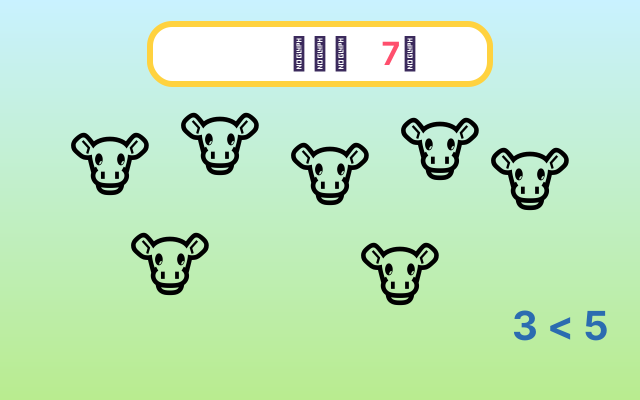
Count & Compare
Count farm animals from 1 to 10, compare which group has more, use >, < and =, and find who is 3rd in line.
Play now →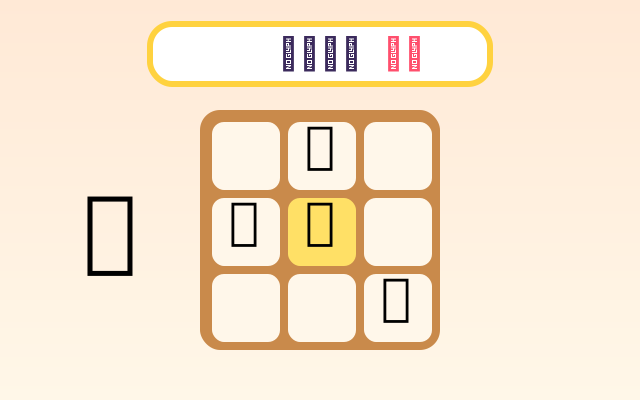
Where Is It?
Above, below, in front, behind, left and right: find things on the shelf, place them where asked and plan the bunny’s path.
Play now →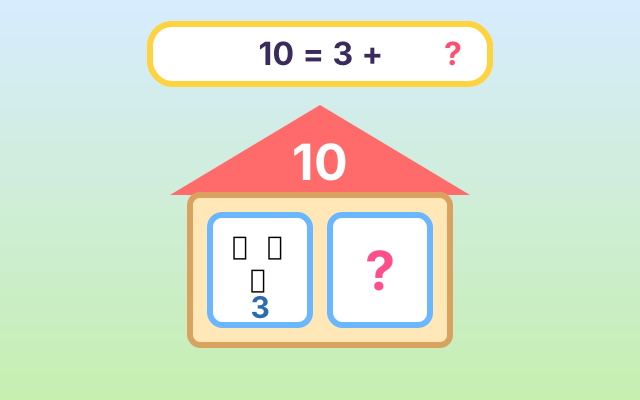
Number Houses
Split numbers up to 10 into two windows, put them back together, and pair up cards that make 10.
Play now →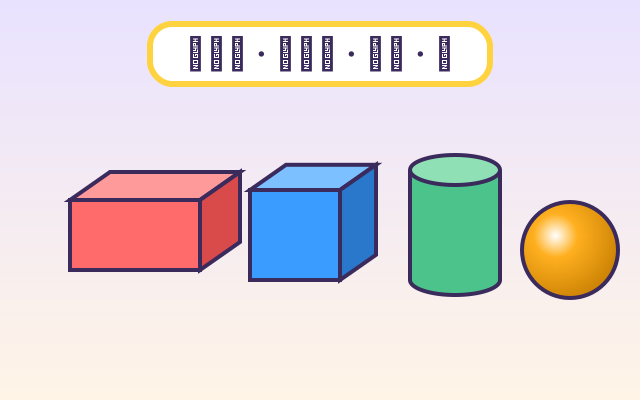
3D Shape House
Cuboids, cubes, cylinders and spheres: name them, find them all, solve riddles, count a pile and build steadily.
Play now →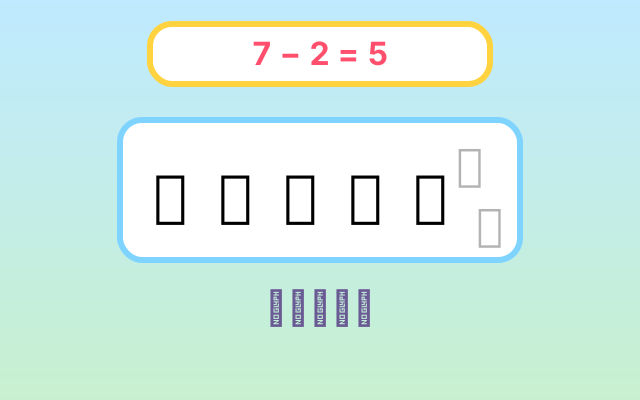
Picture Sums
Look at the picture and pick the right number sentence: altogether, how many left, the missing part, and a bus with people getting on and off.
Play now →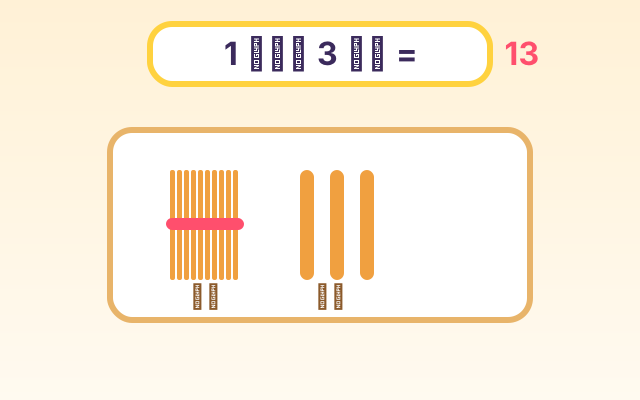
Stick Bundles
Bundle 10 sticks into one ten to learn 11–20: tens and ones, the place-value counter, 10 + a number and number order.
Play now →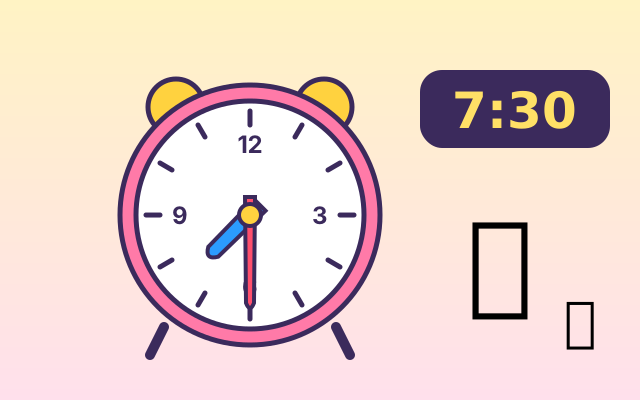
Bear’s Alarm Clock
Level 1 is all about o’clock times — the clock unit of this term. Later levels move on to half past and minutes.
Play now →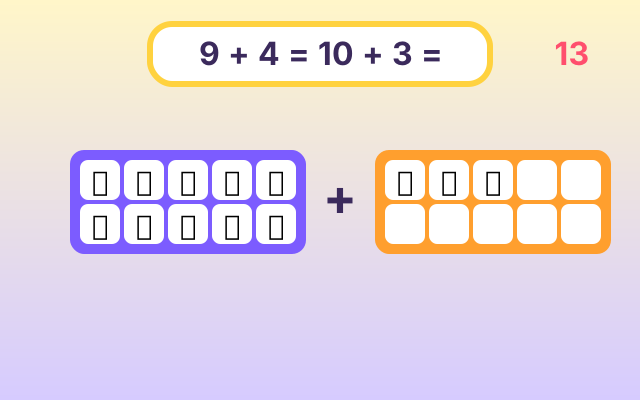
Make-Ten Magic Box
Add within 20 the make-ten way: move gems to fill the magic box to 10, then add the rest. 9 + n, 8 + n, all the way to 2 + n.
Play now →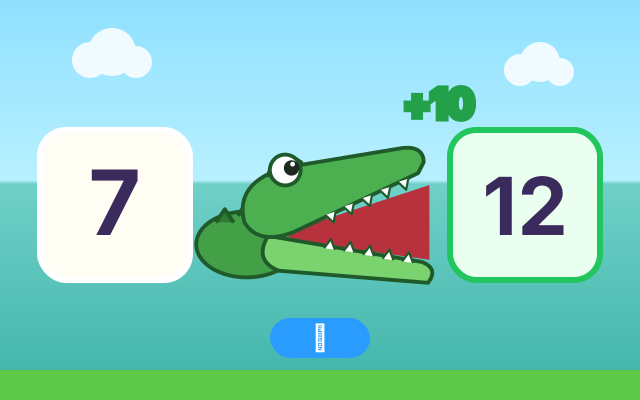
Hungry Croc
Levels 1–3: compare numbers within 10 and 20 with >, < and = — feed the crocodile the bigger side!
Play now →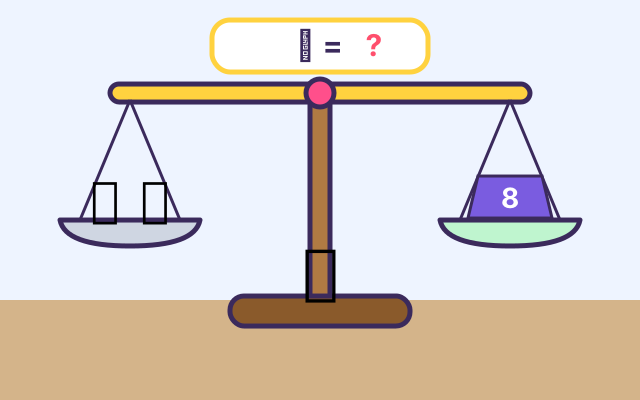
Bear's Balance
Make both pans equally heavy: number bonds, making a number and simple equations within 10 and 20.
Play now →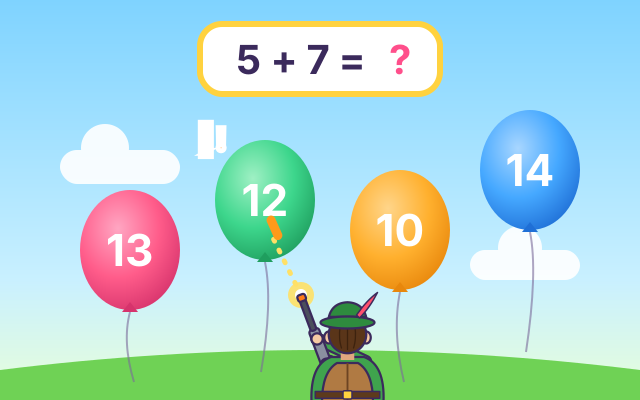
Math Balloons
Levels 1–5: shoot the balloon with the answer to sums within 10 and 20.
Play now →
Math Board Game (Term 1)
Race the bear on a board game. Roll the dice and answer a question on every square — a wrong answer sends you back one step.
Play now →📐 Maths · PEP › Grade 1 Maths · Term 2
Shapes, subtraction, numbers to 100, money, patterns — unit by unit.
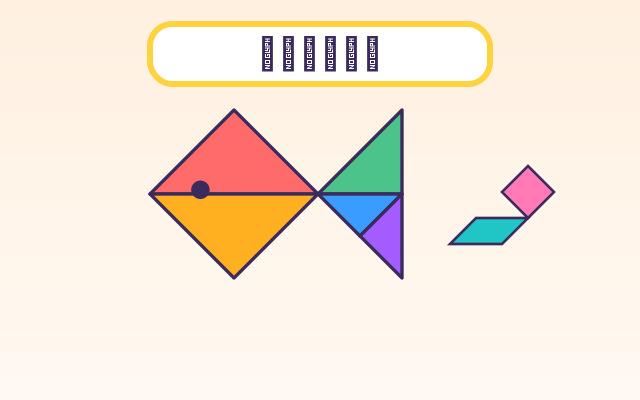
Tangram Fun
Meet the 7 tangram pieces, combine two triangles into new shapes, build a house, a fish and the big square, and count flat shapes.
Play now →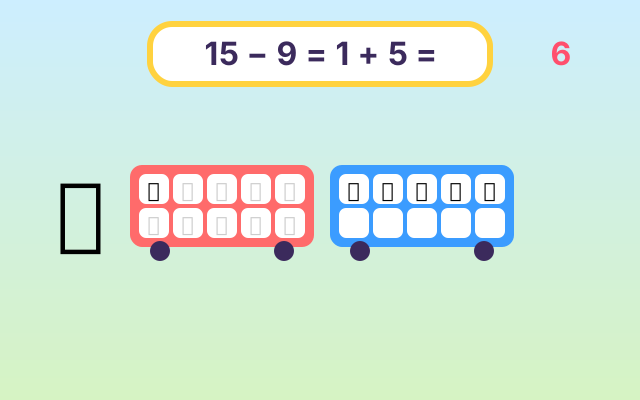
Break-Ten Train
Subtract within 20 by breaking a ten: passengers leave the 10-seat carriage first. Also use addition to subtract and compare how many more.
Play now →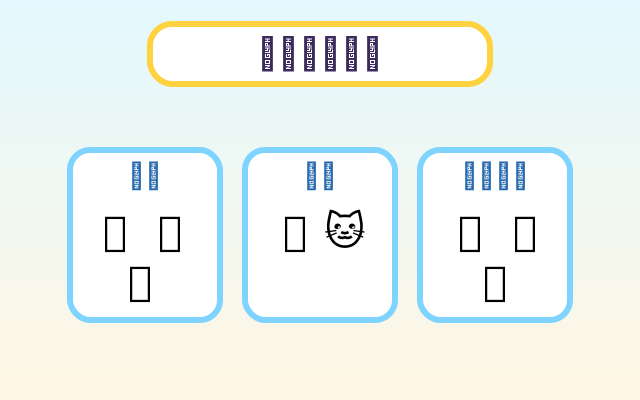
Little Sorter
Sort things by kind, colour or shape, split them into two groups, then read the picture chart: which has the most?
Play now →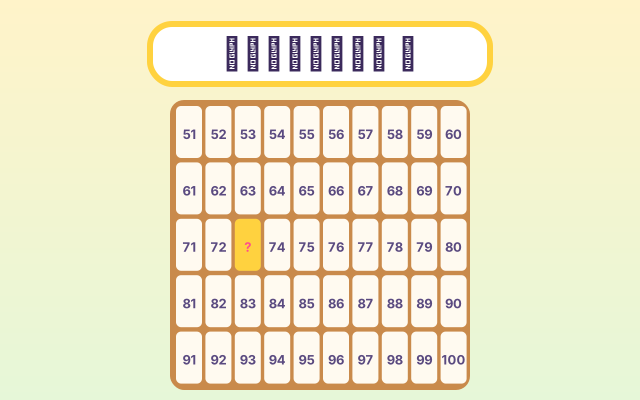
Hundred-Chart Treasure
Numbers to 100: fill the hundred chart, tens and ones, compare, “a bit more” vs “much more”, and hunt for hidden treasure.
Play now →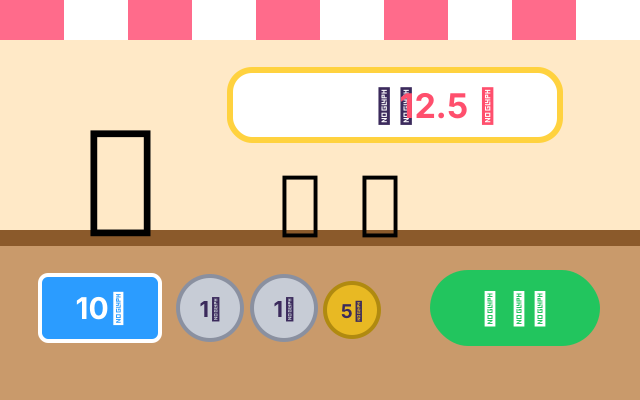
Little Cashier
Now with new levels for this term: swap yuan for jiao, and choose two items that cost exactly the money a customer brought.
Play now →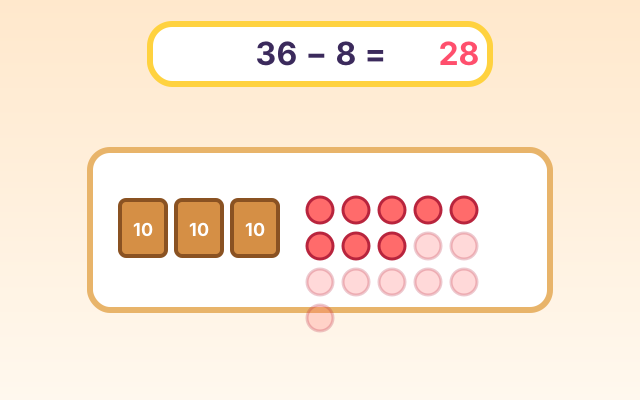
Parcel Station Sums
Add and subtract within 100 with crates of ten: whole tens, carrying, and opening a crate when there aren’t enough ones.
Play now →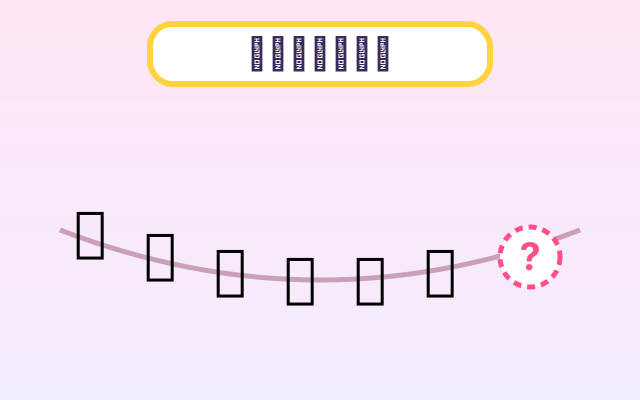
Pattern Beads
Find the repeating part, put back the missing beads, continue number patterns, spot the odd one out and predict the 10th bead.
Play now →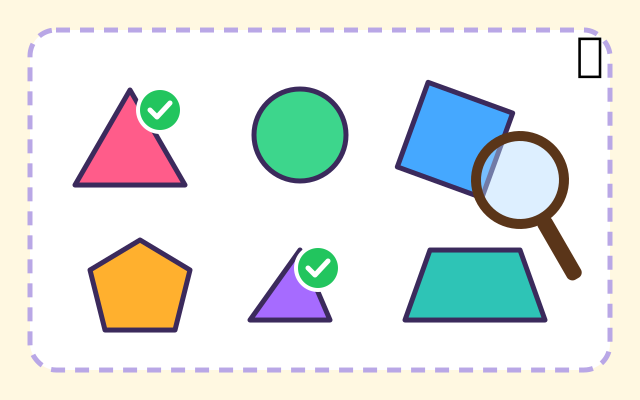
Shape Detective
Levels 1–3: find triangles even when tilted, and count sides and corners of flat shapes.
Play now →
Math Balloons
Levels 4–6: subtraction within 20 with regrouping and sums within 50.
Play now →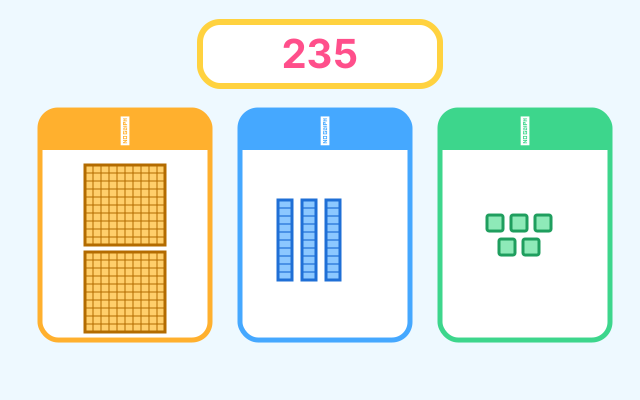
Place Value Blocks
Levels 1–2: tens and ones, and numbers up to 100 with place-value blocks.
Play now →
Hungry Croc
Level 4: compare numbers up to 100 — check the tens first.
Play now →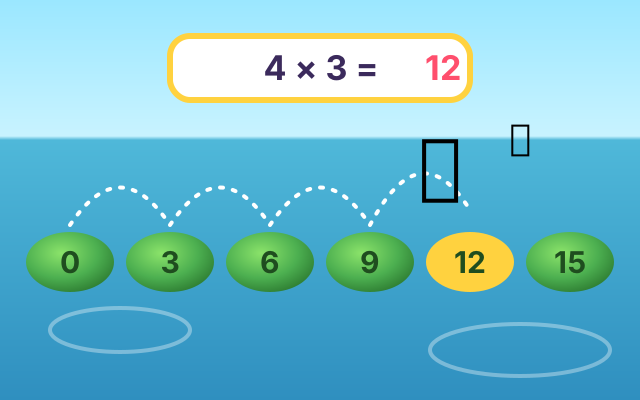
Frog Hop
Hop along the number line: count on, count back, skip-count, patterns and numbers up to 100.
Play now →
Math Board Game (Term 2)
The same board-game race with questions from the whole second term: subtraction, numbers to 100, money, patterns and shapes.
Play now →📐 Maths · PEP › Grade 2 Maths · Term 1
Lengths, written sums, angles, times tables, views, time and combinations.
Ruler Measuring
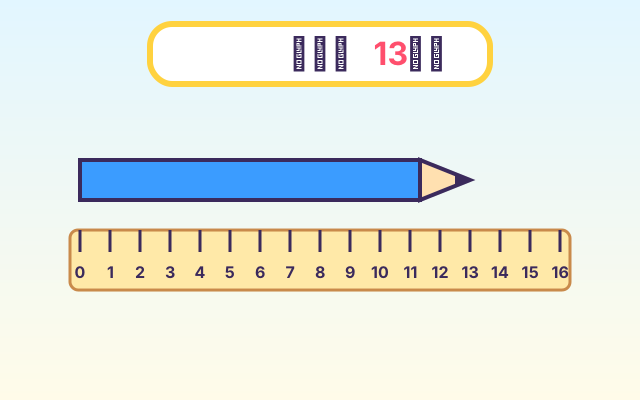
Measure with a ruler — even when the object doesn’t start at 0 — pick centimetres or metres, spot line segments and use 1 m = 100 cm.
Play now →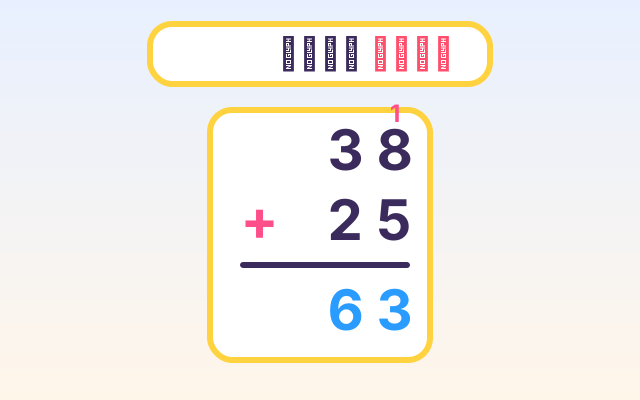
Column Sums Factory
Written addition and subtraction within 100: fill the ones digit, then the tens, with carrying and borrowing shown step by step.
Play now →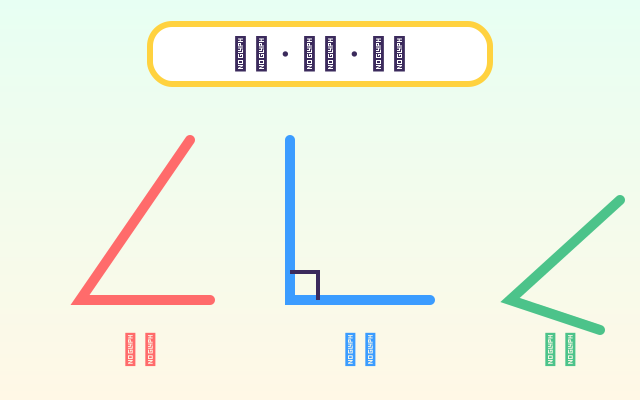
Angle Detective
Find real angles, learn vertex and sides, spot right angles, sort acute, right and obtuse angles, and combine set-square angles.
Play now →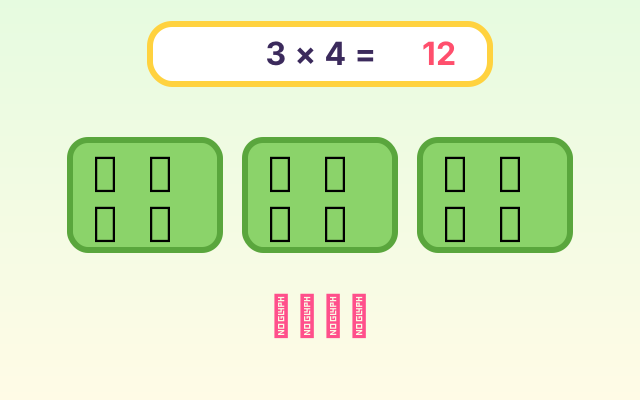
Times-Table Garden
Flower beds with equal groups: “3 groups of 4”, turning repeated addition into ×, the 2–9 times-table rhymes, and multiply-then-add.
Play now →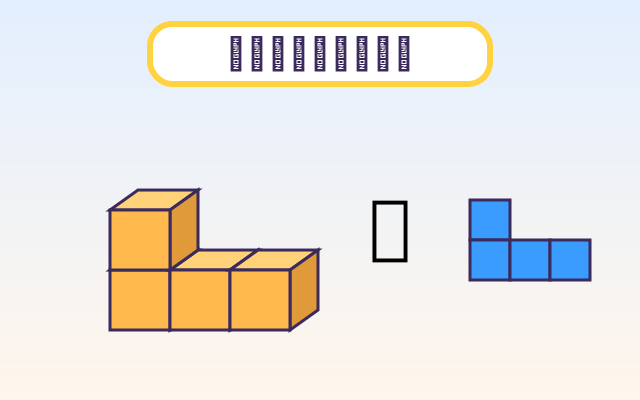
From Another Angle
Look at a pile of blocks from the front or from above and pick what you would see — plus how cylinders, cubes and balls look.
Play now →
Bear’s Alarm Clock
Levels 2–6 cover this term’s clock unit: half past, quarter past, 5-minute steps and single minutes.
Play now →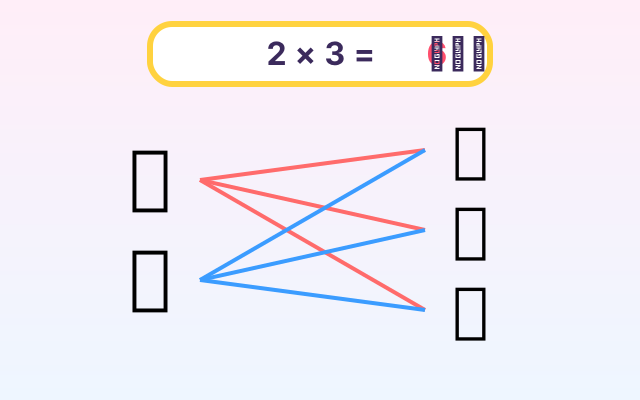
Mix & Match
Find every outfit, build every two-digit number from cards (watch out for 0!), count handshakes, and work out how many choices.
Play now →
Math Balloons
Levels 7–8: shoot the right answer for the 2–9 times tables.
Play now →
Frog Hop
Level 5: equal hops on the number line show what multiplication means.
Play now →
Math Board Game (Gr 2 · T1)
Race the bear with questions from the whole term: lengths, written sums, angles, times tables, time and combinations.
Play now →📐 Maths · PEP › Grade 2 Maths · Term 2
Surveys, division, symmetry, order of operations, numbers to 10,000, weight and logic.
Traffic Survey
Record passing cars with tally marks (正), read survey tables, and decide what most classmates like.
Play now →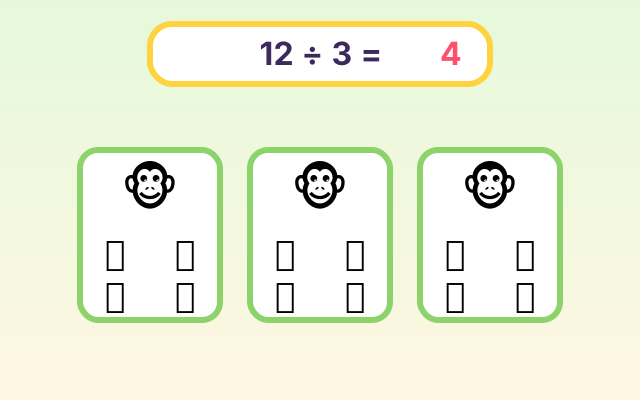
Monkeys Share Peaches
Share fairly, make groups, use times tables to divide, then divisions with a remainder and real-life questions like how many buses.
Play now →
Flip, Slide & Turn
Spot symmetric shapes, complete a mirror picture, tell slides from turns, count how far a shape moved and read the minute hand.
Play now →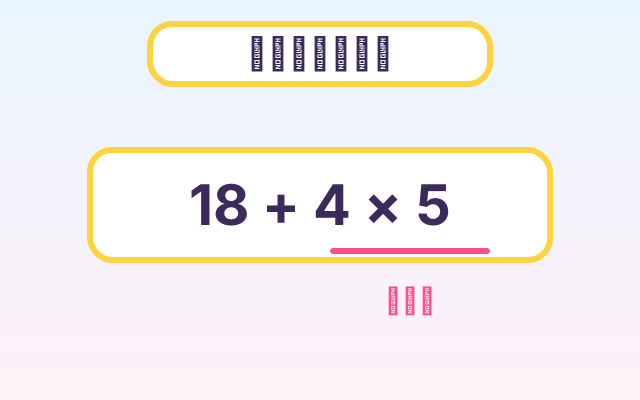
Which Step First?
Tap the operation to do first — left to right, × and ÷ before + and −, brackets first — then finish the sum and write word problems as one expression.
Play now →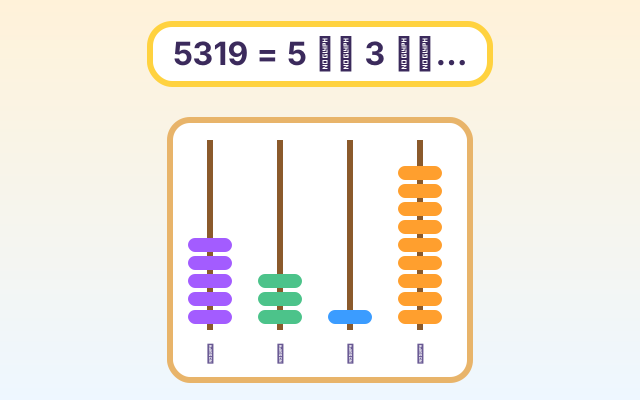
Numbers to 10,000
Thousands on the counter, reading and writing big numbers (with 零!), place value, comparing, rounding and adding whole hundreds.
Play now →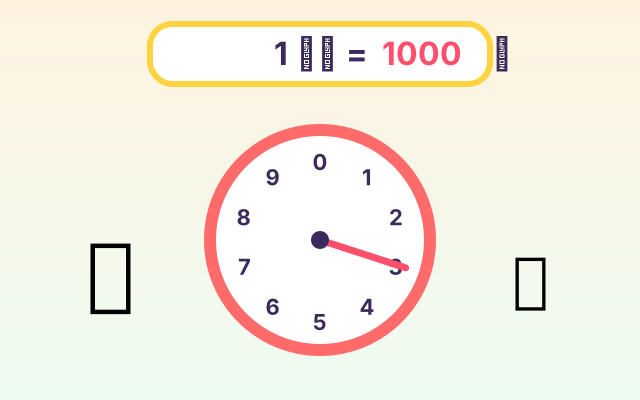
Little Weigher
Grams or kilograms? 1 kg = 1000 g, read the dial on a scale, compare weights and solve shopping questions.
Play now →
Logic Detective
Use clues to work out who has which card, who came first, and fill a 3×3 grid so every row and column has each shape once.
Play now →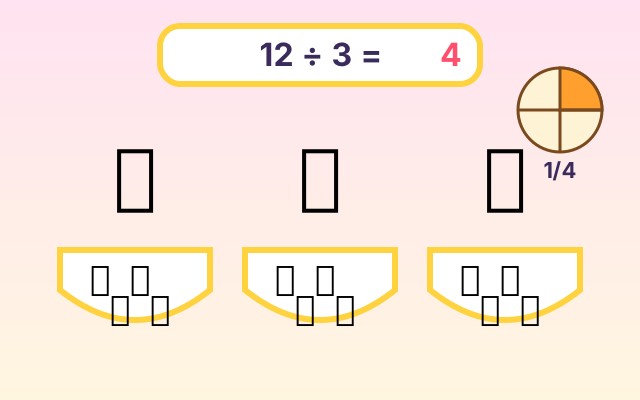
Candy Sharing
Share sweets fairly: equal sharing, division, and what to do with the remainder.
Play now →
Shape Detective
Levels 4–5: spot symmetric shapes and draw the other half of a mirror picture.
Play now →
Place Value Blocks
Levels 3–5: read and build three-digit numbers, and carry ten ones into a ten.
Play now →
Bear's Balance
Levels 4–5: work out how heavy each fruit is from what balances — a first taste of reasoning.
Play now →
Math Board Game (Gr 2 · T2)
Race the bear with questions from the whole term: division, remainders, mixed operations, numbers to 10,000, weight and shape moves.
Play now →📐 Maths · PEP › Grade 3 Maths · Term 1
Answer by playing: snake, garden defence, tanks, fishing, racing, catching and more.
Second-Hand Race
Read seconds, convert hours, minutes and seconds, and work out elapsed time. Answer by steering a snake, defending a garden, driving a tank, fishing, racing or catching fruit.
Play now →
Add & Subtract Quest
Mental sums, three-digit written addition and subtraction, and estimating.
Play now →
Measuring Master
Millimetres, decimetres, kilometres and tonnes: read, choose and convert units.
Play now →
Times-As-Many Train
See “times as many” in pictures, then find the multiple or how many times.
Play now →
Multiplication Factory
Multiply by a one-digit number: mental, written with zeros, and estimates.
Play now →
Perimeter Track
Spot quadrilaterals, count perimeters on a grid and calculate them for rectangles and squares.
Play now →
Fraction Pizza
Unit and non-unit fractions, comparing, adding like fractions and a fraction of a number.
Play now →
Venn Circles
Read two overlapping circles and count who joined one, the other or both.
Play now →
Math Board Game (Gr 3 · T1)
Race the bear with review questions from the whole term.
Play now →📐 Maths · PEP › Grade 3 Maths · Term 2
Answer by playing: snake, garden defence, tanks, fishing, racing, catching and more.
Compass Explorer
North, south, east, west and the in-between directions, plus following a route on a map.
Play now →
Packing Factory
Divide by one digit: mental, written, zeros in the quotient and real-life questions.
Play now →
Table Reader
Read two-way tables, add up totals and compare groups.
Play now →
Multiplication Quest
Two-digit by two-digit: mental, estimating, written and word problems.
Play now →
Tiling Floors
Count squares, choose area units, find area of rectangles and tell area from perimeter.
Play now →
Calendar Detective
Long and short months, leap years, the 24-hour clock and reading a calendar.
Play now →
Decimal Market
Write money and lengths as decimals, compare them and add or subtract.
Play now →
Math Board Game (Gr 3 · T2)
Race the bear with review questions from the whole term.
Play now →📐 Maths · PEP › Grade 4 Maths · Term 1
Answer by playing: snake, garden defence, tanks, fishing, racing, catching and more.
Into the Hundred Millions
Place value up to hundreds of millions, reading, rewriting with 万 and 亿, and rounding.
Play now →
Land Surveyor
Hectares and square kilometres: convert, choose units and calculate land area.
Play now →
Protractor Pro
Lines and rays, reading a protractor, angle types, angle sums and clock angles.
Play now →
Multiplication Express
Three-digit by two-digit, zeros at the end, how products change, and speed × time.
Play now →
Parallel Lines
Parallel and perpendicular lines, parallelograms, trapeziums and heights.
Play now →
Estimation Ace
Divide by two digits: estimate the quotient, check its size and use how quotients change.
Play now →
Bar Charts
Read bar charts, compare bars and work out what one square stands for.
Play now →
Time Manager
Make tea, cook pancakes and queue in the quickest way.
Play now →
Math Board Game (Gr 4 · T1)
Race the bear with review questions from the whole term.
Play now →📐 Maths · PEP › Grade 4 Maths · Term 2
Answer by playing: snake, garden defence, tanks, fishing, racing, catching and more.
Clever Calculator
Order of operations, zero, the laws of arithmetic and shortcuts like 25 × 4.
Play now →
Block Views
Pick what a block model looks like from the front, the left and the top.
Play now →
Decimal Kingdom
Meaning of decimals, place value, trailing zeros, moving the point, rounding and adding.
Play now →
Triangle Workshop
Side lengths, the 180° angle sum, and sorting triangles by angles and sides.
Play now →
Mirror Lines
Count lines of symmetry, complete a mirror picture and measure a slide.
Play now →
Average Balance
Level out stacks, calculate averages and read double bar charts.
Play now →
Chickens & Rabbits
The classic puzzle: toggle animals in the cage, then solve it by assuming.
Play now →
Math Board Game (Gr 4 · T2)
Race the bear with review questions from the whole term.
Play now →📐 Maths · PEP › Grade 5 Maths · Term 1
Each game answers in a different way: hoops, tanks, fishing, racing, catching and more.
Decimal Workshop
Multiply and divide decimals and put the decimal point in the right place; rounding and repeating decimals.
Play now →
Grid Positions
Read and write positions as (column, row), find points, slide them and spot patterns.
Play now →
Equation Balance
Letters for numbers, what an equation is, balance scales and solving x + a = b, ax = b and word problems.
Play now →
Lucky Draw
Certain, possible or impossible? Compare chances, decide if a game is fair and fill the bag.
Play now →
Polygon Areas
Find the base and height: areas of parallelograms, triangles, trapezoids and composite shapes.
Play now →
Tree Planting
Count the gaps: trees at both ends, one end, no ends or round a circle; sawing wood and climbing stairs.
Play now →📐 Maths · PEP › Grade 5 Maths · Term 2
Each game answers in a different way: hoops, tanks, fishing, racing, catching and more.
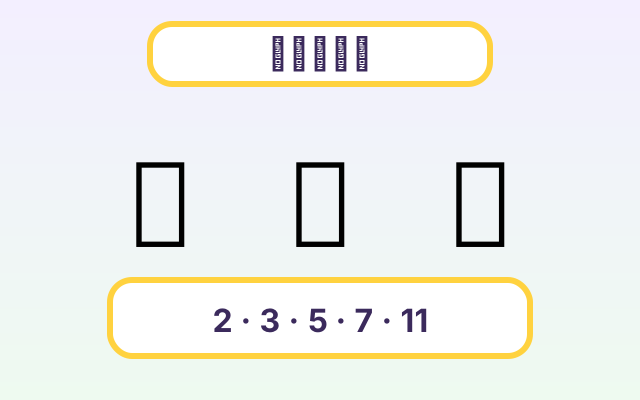
Factor Detective
Factors and multiples, the tests for 2, 5 and 3, primes and composites, odd and even.
Play now →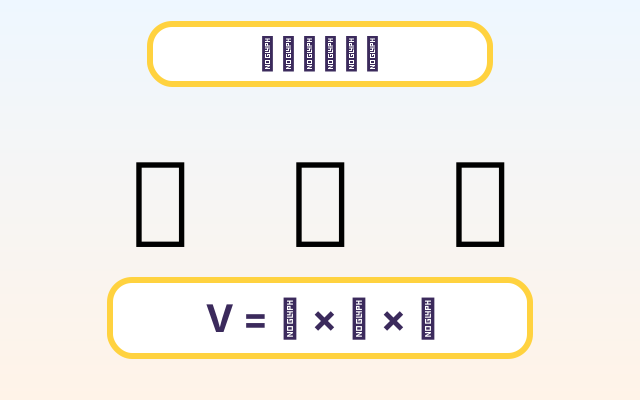
Box Workshop
Faces, edges and vertices; total edge length, surface area and volume; litres and cubic units.
Play now →
Spinning Windmill
Clockwise or anticlockwise, how many degrees, where it ends up, and what stays the same in a rotation.
Play now →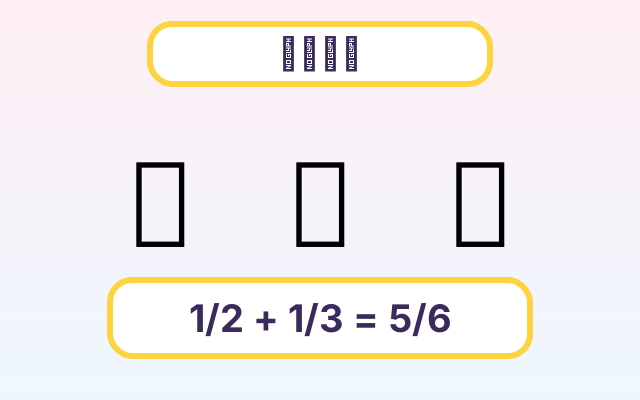
Fraction Park
What fractions mean, proper and improper fractions, simplifying, common denominators and adding fractions.
Play now →
Line Graph Weather Station
Read line graphs: values, highest and lowest, biggest change, double line graphs and choosing a chart.
Play now →
Find the Fake
Use a balance to find the lighter fake: read the scales, split into three and count the weighings.
Play now →📐 Maths · PEP › Grade 6 Maths · Term 1
One game per textbook unit, answered with hoops, tanks, fishing, racing and more.
Fraction Multiplication
Multiply fractions, find a fraction of a number and meet reciprocals.
Play now →
Directions & Distance
Bearings like “north 30° east”, scale distances and locating places.
Play now →
Fraction Division
Divide by multiplying by the reciprocal; find the whole; work problems.
Play now →
Ratio Park
Write ratios, find their value, simplify and share in a ratio.
Play now →
World of Circles
Radius and diameter, circumference, area and rings.
Play now →
Percent Station
Convert percentages, find rates and read pie charts.
Play now →📐 Maths · PEP › Grade 6 Maths · Term 2
One game per textbook unit, answered with hoops, tanks, fishing, racing and more.

Negative Thermometer
Negative numbers, opposite quantities, the number line and temperature gaps.
Play now →
Shopping Percents
Discounts, growth, tax and interest.
Play now →
Cylinders & Cones
Lateral area, surface area and volume of cylinders; volume of cones.
Play now →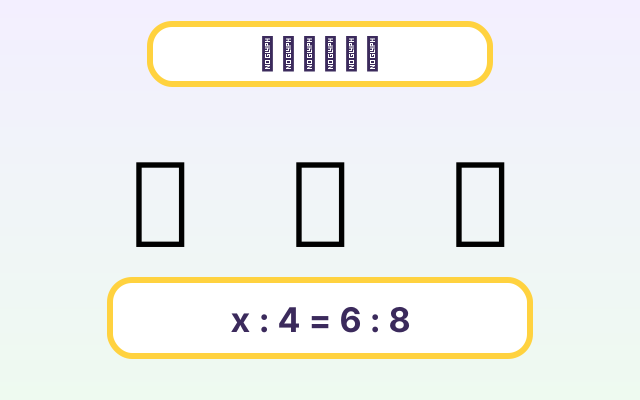
Proportion & Scale
Proportions, direct and inverse variation, and map scales.
Play now →
Pigeonhole Puzzles
Pigeons and holes: guarantee a match with the worst case.
Play now →📐 Maths · 🎬 Lesson videos › One idea in under a minute
Watch a short animation, then read the key points and try the questions underneath.
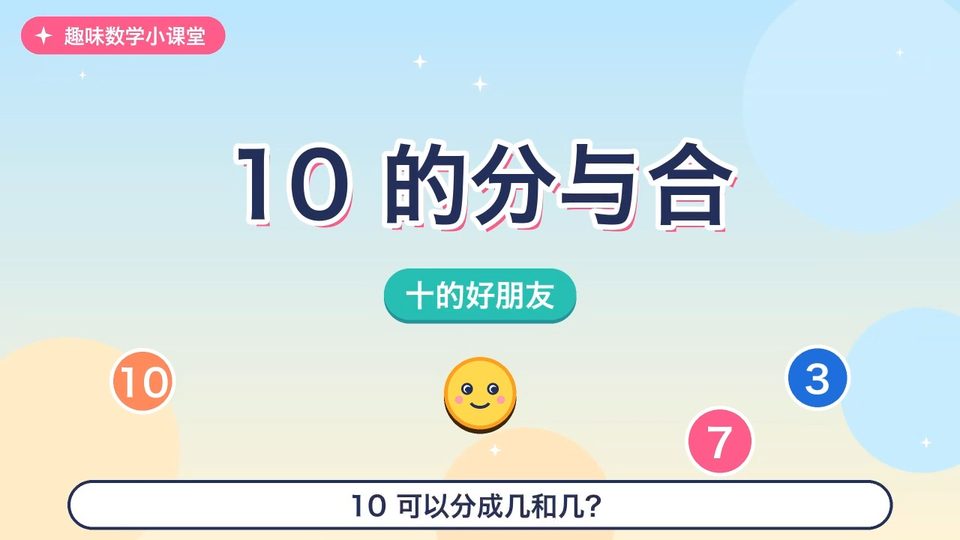 0:27
Number Bonds of 10
Split 10 dots with a stick: 1 and 9, 2 and 8, 3 and 7, 4 and 6, 5 and 5 — and back again. Learn the “friends of 10”.
📘 Grade 1 · Numbers 6 to 10- 10 can be split into two parts in different ways: 1 and 9, 2 and 8, 3 and 7, 4 and 6, 5 and 5.
- Swap the two parts and it still makes 10: 9 and 1, 8 and 2, 7 and 3, 6 and 4.
- Two parts put back together make 10 again, e.g. 3 + 7 = 10.
- These pairs are the “friends of 10”. Knowing them by heart makes adding up to 20 (the make-ten trick) much faster.
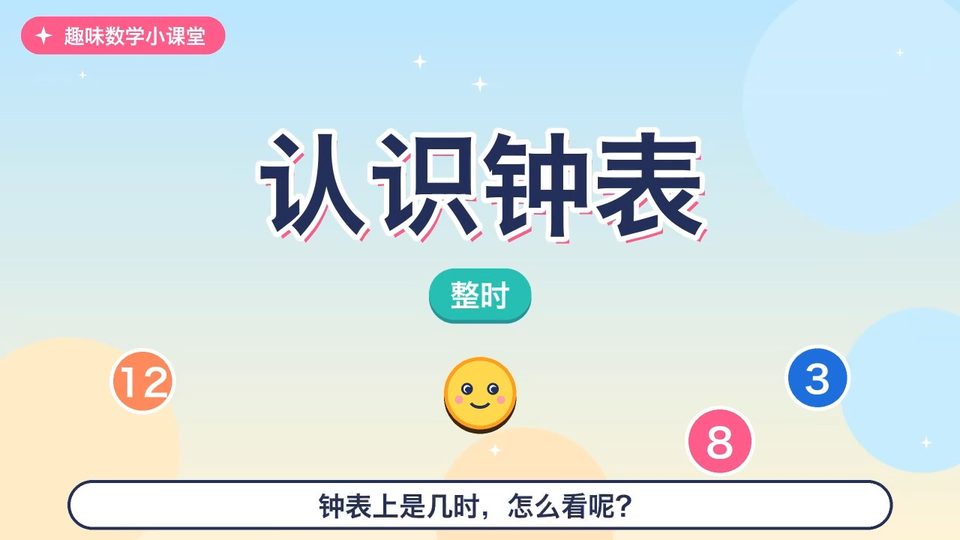 0:27
Telling the Time: O'Clock
Meet the hour hand and the minute hand. When the minute hand points to 12, the hour hand tells you the hour: 3 o'clock, 8 o'clock.
📘 Grade 1 · Telling the time- A clock face has the numbers 1 to 12.
- The short, thick hand is the hour hand; the long, thin hand is the minute hand.
- O'clock: when the minute hand points to 12, the hour hand points to the hour, e.g. 3 o'clock.
- A digital clock writes 3 o'clock as 3:00 and 8 o'clock as 8:00.
- From 3 o'clock to 8 o'clock the minute hand goes round 5 times while the hour hand moves from 3 to 8.
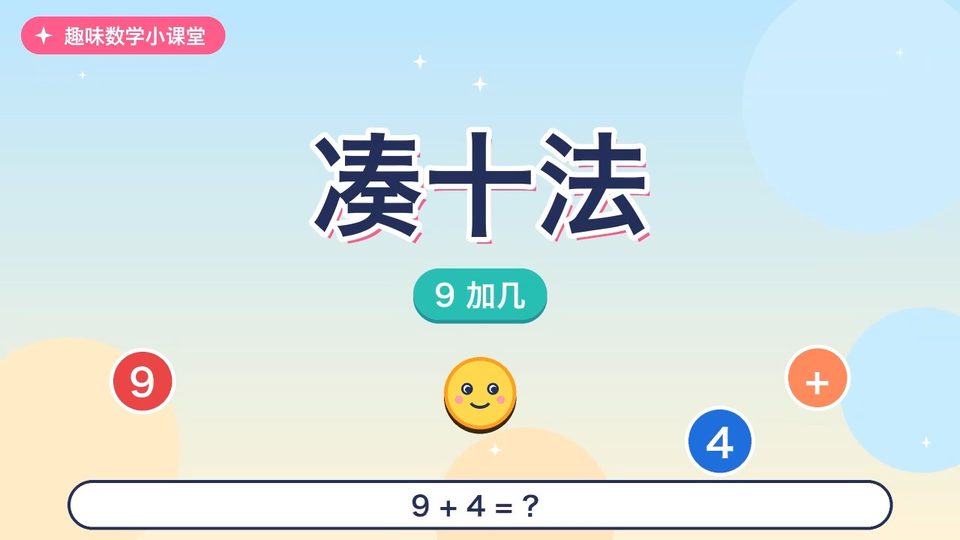 0:25
The Make-Ten Trick: 9 + 4
9 needs 1 more to make 10, so split 4 into 1 and 3: 9 + 1 = 10, then 10 + 3 = 13. Watch it happen in a ten-frame.
📘 Grade 1 · Adding within 20- 9 + 4: 9 needs 1 more to make 10.
- Split the smaller number: 4 = 1 and 3.
- First make ten: 9 + 1 = 10. Then add the rest: 10 + 3 = 13.
- Make-ten steps: look at the bigger number, split the smaller one, make 10, then add the rest.
- It works for 8 + 5, 7 + 6 and so on: 8 needs 2, 7 needs 3.
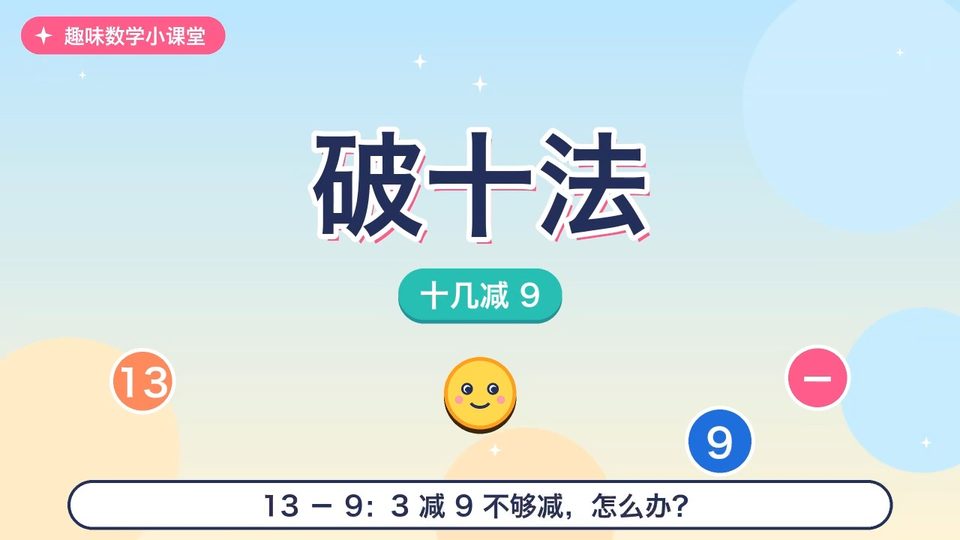 0:27
The Break-Ten Trick: 13 − 9
3 is too small to take away 9, so open the bundle of ten: 10 − 9 = 1, then 1 + 3 = 4. So 13 − 9 = 4.
📘 Grade 1 · Subtracting within 20- 13 is one ten and 3 ones: a bundle of 10 sticks and 3 loose sticks.
- 3 is too small to take away 9, so break the ten.
- Take 9 from the ten: 10 − 9 = 1.
- Put what is left together: 1 + 3 = 4. So 13 − 9 = 4.
- Break-ten steps: split off the ten, subtract from it, then add the leftovers.
 0:20
Yuan, Jiao and Fen
Swap money: one 1-yuan note is ten 1-jiao coins, and one 1-jiao coin is ten 1-fen coins. Then pay 3 yuan 5 jiao for a pencil.
📘 Grade 1 · Money- Chinese money (RMB) is counted in yuan, jiao and fen.
- 1 yuan = 10 jiao, and 1 jiao = 10 fen.
- 3 yuan 5 jiao can be paid with three 1-yuan notes and five 1-jiao coins.
 0:25
Tens and Ones
Bundle ten sticks into one ten. 3 bundles and 5 loose sticks make 35: 3 in the tens place and 5 in the ones place.
📘 Grade 1 · Numbers to 100- 10 ones = 1 ten: bundle ten sticks together.
- 35 is made of 3 tens and 5 ones.
- The digit in the tens place tells how many tens; the digit in the ones place tells how many ones.
 0:34
What Is Multiplication?
3 plates with 4 apples each: 4 + 4 + 4 = 12 becomes “3 fours”, written 3 × 4 = 12. With 10 plates, multiplication wins by a mile.
📘 Grade 2 · Intro to multiplication- Equal groups: 3 plates with 4 apples on each plate is “3 fours”.
- Adding the same number again and again: 4 + 4 + 4 = 12.
- Multiplication is a quick way to add equal numbers: 3 fours is written 3 × 4 = 12 (or 4 × 3 = 12).
- In 3 × 4 = 12, 3 and 4 are the factors and 12 is the product. The sign × is read “times”.
- The more groups there are, the more time it saves: 10 fours is just 10 × 4 = 40.
 0:34
The 9 Times Table Finger Trick
Hold up ten fingers and fold down the 3rd: 2 fingers on the left, 7 on the right, so 9 × 3 = 27. Works all the way from 9 × 1 to 9 × 9.
📘 Grade 2 · The 9 times table- Hold up both hands and number the fingers 1 to 10 from left to right.
- To work out 9 × n, fold down finger number n.
- Fingers on the left of the folded one give the tens; fingers on the right give the ones.
- 9 × 3: 2 on the left, 7 on the right → 27. 9 × 7: 6 on the left, 3 on the right → 63.
- Pattern: from 9 × 1 to 9 × 9 the tens go up by 1 and the ones go down by 1, and the two digits always add up to 9.
 0:28
Why Is the Remainder Smaller Than the Divisor?
Make squares from 13 sticks, 4 sticks each: 3 squares and 1 left over, so 13 ÷ 4 = 3 R 1. If 4 were left, you could make one more square!
📘 Grade 2 · Division with remainders- 13 sticks, 4 sticks per square: 3 squares, with 1 stick left over.
- Written as 13 ÷ 4 = 3 R 1: 13 is the dividend, 4 the divisor, 3 the quotient and 1 the remainder.
- If 4 sticks were left, they would make one more square, so the remainder can never be 4 (or more).
- Rule: the remainder is always smaller than the divisor. When dividing by 4, the remainder can only be 1, 2 or 3.
- Check: quotient × divisor + remainder = dividend → 3 × 4 + 1 = 13.
 0:25
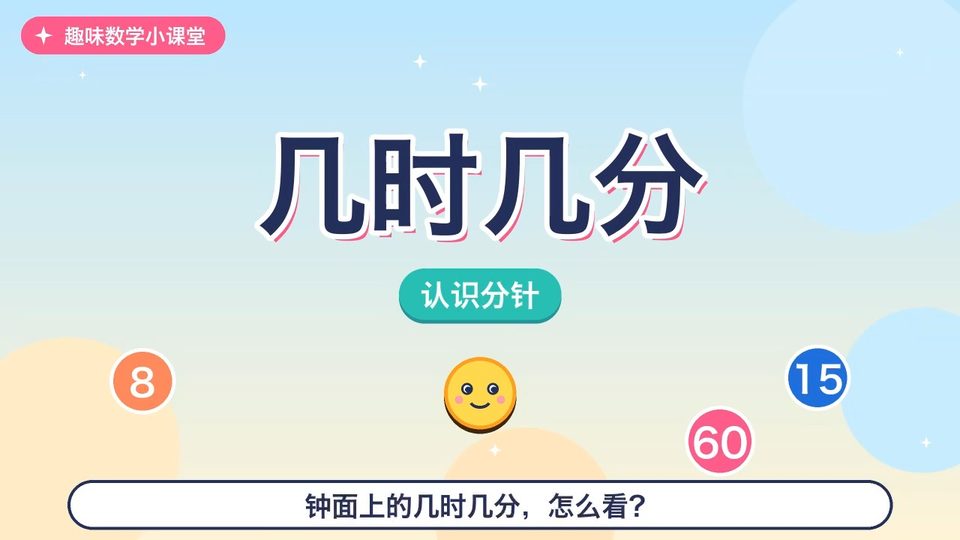
Hours and Minutes
The minute hand moves 1 minute per small mark and 5 minutes per big mark. Hour hand just past 8, minute hand on 3: 8:15.
📘 Grade 2 · Telling the time- The clock face has 60 small marks: the minute hand moves 1 minute per small mark.
- Each big mark (number) is 5 minutes.
- First look at which number the hour hand has passed, then count the minutes.
- 8:15 means 8 hours 15 minutes.
 0:26
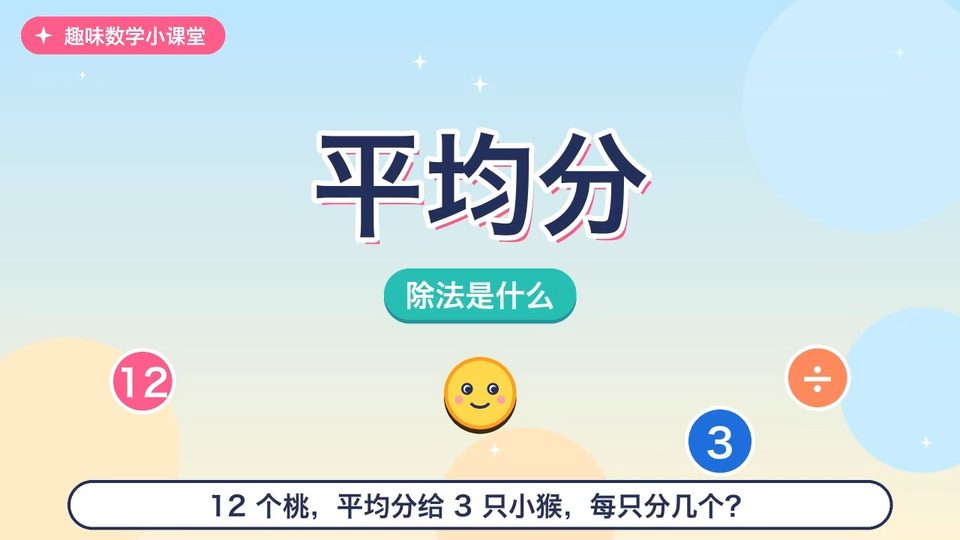
Sharing Equally: What Division Means
Share 12 peaches among 3 monkeys, one round at a time. Each gets 4: that is sharing equally, written 12 ÷ 3 = 4.
📘 Grade 2 · Division- Sharing equally: every share gets the same amount.
- Hand out one each, round after round, until nothing is left.
- 12 shared among 3 is written 12 ÷ 3 = 4: 12 is the dividend, 3 the divisor, 4 the quotient.
- Check with multiplication: 3 × 4 = 12.
 0:26
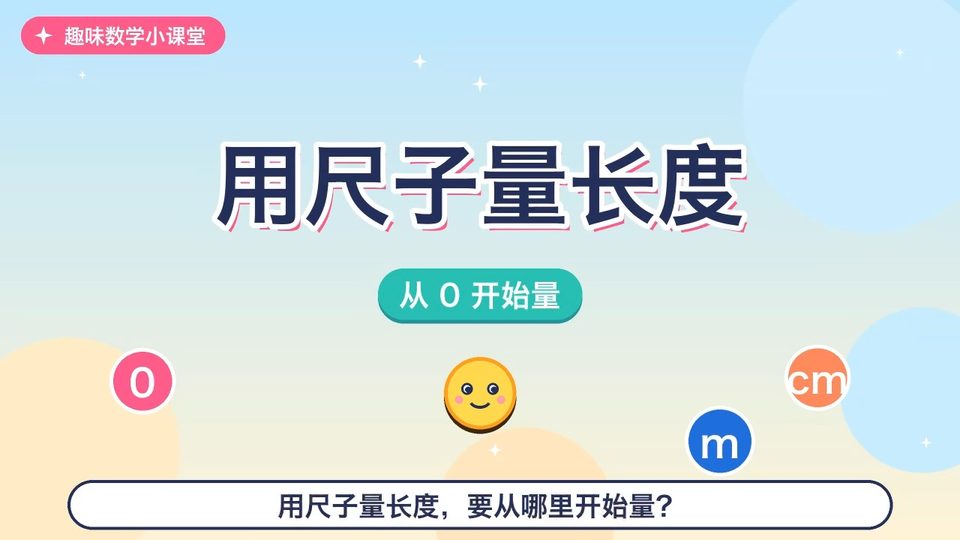
Measuring with a Ruler
Line one end up with 0 and read where the other end points: 6 cm. If you start at 2 and end at 8, subtract: 8 − 2 = 6 cm. And 1 m = 100 cm.
📘 Grade 2 · Centimetres and metres- Line up one end of the object with the 0 mark; the other end shows the length.
- If you don’t start at 0, subtract: end − start, e.g. 8 − 2 = 6 cm.
- Short things are measured in centimetres (cm), long things in metres (m): 1 m = 100 cm.
 0:26
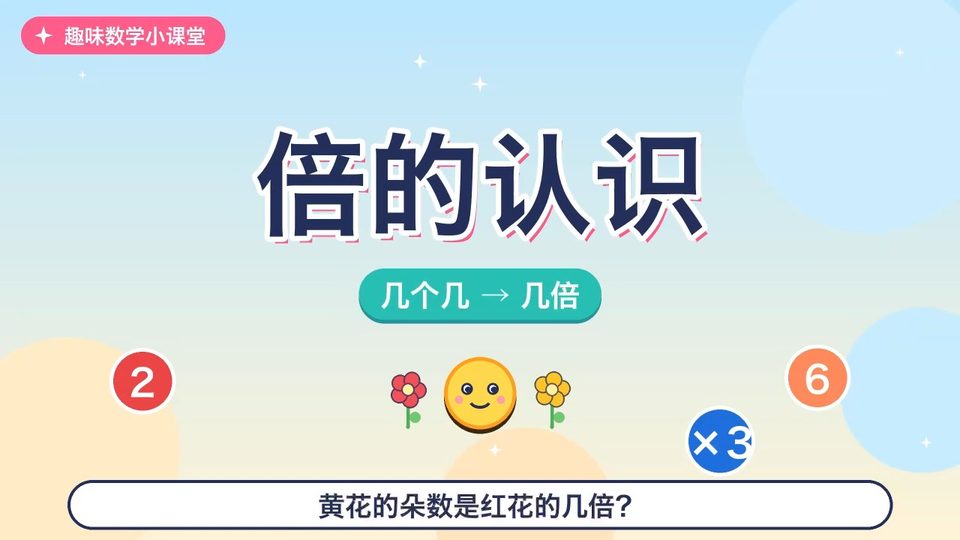
Times As Many
2 red flowers and 6 yellow ones: circle the yellow flowers in twos and you get 3 groups, so there are 3 times as many. Then 6 ÷ 2 = 3.
📘 Grade 3 · Times as many- Take the smaller amount as one group: 2 red flowers.
- Circle the yellow flowers 2 at a time: there are 3 twos.
- So the yellow flowers are 3 times as many as the red ones.
- To find “how many times”, divide: 6 ÷ 2 = 3.
- In general: if A contains n groups of B, then A is n times B.
 0:28
Meet Fractions
Cut a pizza into 2 equal parts: each part is 1/2. Learn the numerator and denominator, then 1/4 and 3/4 — and why the parts must be equal.
📘 Grade 3 · Fractions- Cut something into 2 equal parts: each part is one half (1/2).
- The bottom number is the denominator: how many equal parts.
- The top number is the numerator: how many parts we take.
- Cut into 4 equal parts: one part is 1/4, three parts are 3/4.
- The parts must be equal, otherwise it is not a fraction of the whole.
 0:26
Area of a Rectangle
Cover a 4 cm × 3 cm rectangle with 1 cm² squares: 4 in a row, 3 rows, 12 squares. So area = length × width = 4 × 3 = 12 cm².
📘 Grade 3 · Area- Area: how big a surface or a closed shape is.
- A square with 1 cm sides has an area of 1 square centimetre (1 cm²).
- A 4 cm × 3 cm rectangle holds 4 squares per row and 3 rows: 12 cm².
- Area of a rectangle = length × width; area of a square = side × side.
 0:30
Long and Short Months: The Knuckle Trick
Make a fist and count across your knuckles: knuckles are 31-day months, the dips between them are 30-day months. February is special: 28 or 29 days.
📘 Grade 3 · Years, months and days- Make a fist: the knuckles are long months, the dips between them are short months.
- Count from the left: Jan (knuckle), Feb (dip), Mar (knuckle) … Jul (knuckle), then start again: Aug (knuckle) … Dec.
- Long months (31 days): January, March, May, July, August, October, December.
- Short months (30 days): April, June, September, November.
- February: 28 days in a common year, 29 days in a leap year.
 0:26
How to Use a Protractor
Two things must line up: the centre on the vertex and the zero line on one side. Then read from the zero you started on: 60°, not 120°.
📘 Grade 4 · Measuring angles- Put the protractor’s centre on the vertex of the angle.
- Line up the zero line with one side of the angle.
- Look where the other side crosses the scale, and read the scale that starts at 0 on your side.
- A protractor has two scales (inner and outer); reading the wrong one gives 120° instead of 60°.
 0:23
Parallel and Perpendicular Lines
Two lines on a flat surface that never meet are parallel; lines that cross at a right angle are perpendicular, meeting at the foot of the perpendicular.
📘 Grade 4 · Parallel and perpendicular- In the same plane, two lines either cross or never meet.
- Lines that never meet are parallel: each is a parallel line of the other.
- Lines that cross at a right angle are perpendicular; the crossing point is the foot of the perpendicular.
 0:33
The Pancake Problem
A pan holds 2 pancakes and each side takes 3 minutes. Never leave a space empty and 3 pancakes take 3 rounds, 9 minutes, instead of 12.
📘 Grade 4 · Optimisation- 3 pancakes have 6 sides to cook; the pan cooks 2 sides per round, so at least 6 ÷ 2 = 3 rounds.
- Round 1: pancakes 1 and 2 (side A). Round 2: pancake 1 (side B) and 3 (side A). Round 3: pancakes 2 and 3 (side B).
- 3 rounds × 3 minutes = 9 minutes, instead of 12 if you cook them one pair at a time.
- Key idea: never leave the pan half empty.
 0:27
Reading Big Numbers
Split the number into groups of four from the right: the wan group and the ones group. 30070500 is read 三千零七万零五百.
📘 Grade 4 · Large numbers- In Chinese, numbers are grouped in fours from the right: the ones group (个级) and the wan group (万级, ten-thousands).
- Read the wan group first, as an ordinary 4-digit number, and add “万”; then read the ones group.
- Zeros at the end of a group are not read; one or more zeros in the middle are read as a single “零”.
- Example: 30070500 → 3007 | 0500 → 三千零七万零五百.
 0:34
Chickens and Rabbits in a Cage
8 heads, 26 legs. Ask every animal to lift two legs: 10 legs are left, all rabbit legs, 2 per rabbit. So 5 rabbits and 3 chickens.
📘 Grade 4 · Chickens and rabbits- Every animal has 1 head: chickens have 2 legs, rabbits have 4.
- Lift two legs each: 8 animals lift 8 × 2 = 16 legs, and 26 − 16 = 10 legs stay on the ground.
- Chickens now stand on no legs, so all 10 legs belong to rabbits, 2 each: 10 ÷ 2 = 5 rabbits, 8 − 5 = 3 chickens.
- Check: 3 × 2 + 5 × 4 = 26.
 0:26
Angles of a Triangle Add Up to 180°
Tear off the three corners of a triangle and put them together: they make a straight angle. So the angles of any triangle add up to 180°.
📘 Grade 4 · Triangles- Tear off the three corners and put them side by side: they form a straight angle.
- A straight angle is 180°, so ∠1 + ∠2 + ∠3 = 180°.
- This works for every triangle: right (90° + 45° + 45°), equilateral (60° × 3), obtuse…
- Use it to find a missing angle: 180° minus the other two.
 0:33
The Distributive Law
A rectangle (4 + 6) long and 3 wide splits into 4 × 3 and 6 × 3, so (4 + 6) × 3 = 4 × 3 + 6 × 3. In general (a + b) × c = a × c + b × c.
📘 Grade 4 · Laws of arithmetic- A rectangle (4 + 6) long and 3 wide has area (4 + 6) × 3.
- Cut it into two parts: 4 × 3 and 6 × 3. The total area doesn’t change.
- (a + b) × c = a × c + b × c: multiply each part, then add.
- It makes mental maths easier: 38 × 9 + 62 × 9 = (38 + 62) × 9 = 900.
 0:26
What Decimals Mean
Split a square into 10 equal parts: one part is 1/10 = 0.1. Into 100 parts: one is 1/100 = 0.01. 35 small squares are 0.35.
📘 Grade 4 · Decimals- Take a square as 1. Split it into 10 equal parts: each part is 1/10 = 0.1.
- Split it into 100 equal parts: each part is 1/100 = 0.01.
- 35 out of 100 small squares is 35/100 = 0.35.
- Fractions with denominator 10, 100, 1000… can all be written as decimals: tenths, hundredths, thousandths.
 0:27
Circumference of a Circle
Roll a circle and measure it with its diameter: the circumference is always about 3.14 times the diameter. Meet π and C = πd.
📘 Grade 6 · Circles- Diameter: the straight line through the centre from one side of the circle to the other. It is the longest line inside a circle, written d.
- Circumference: the distance all the way round the circle. Roll the circle one full turn and the distance it travels is its circumference, written C.
- Measure the circumference with the diameter: it fits 3 times and a little bit more.
- Pi (π): circumference ÷ diameter is always the same number, about 3.14.
- Formula: C = πd. Because the diameter is twice the radius, you can also write C = 2πr.
- Example: a diameter of 10 cm gives a circumference of 3.14 × 10 = 31.4 cm.
 0:29
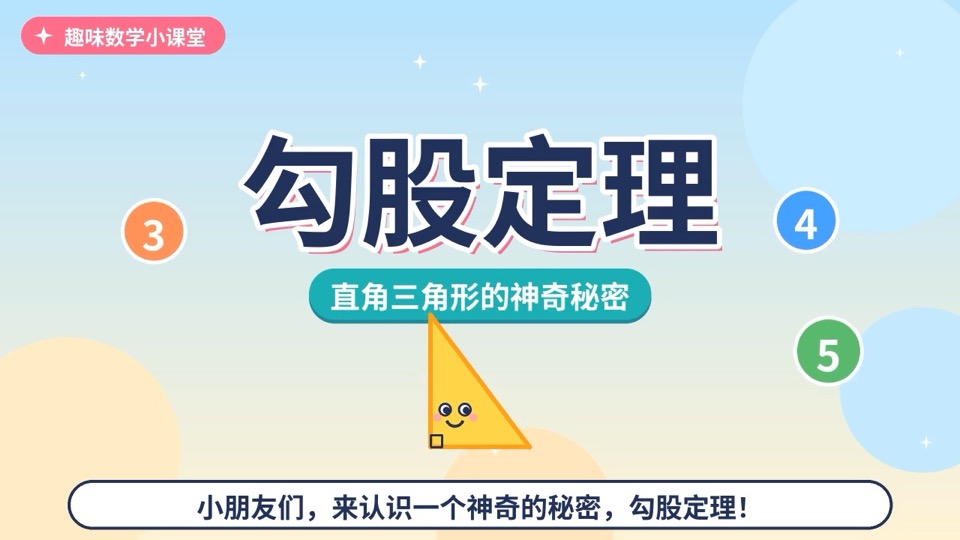
The Pythagorean Theorem
Count the little squares: on a right triangle with sides 3 and 4, 9 + 16 makes exactly 25 — the square of the long side.
📘 Grade 8 · Right triangles (a sneak peek for older primary pupils)- Right triangle: a triangle with one right angle. The two sides forming the right angle are the legs; the longest side opposite it is the hypotenuse.
- Square of a number: the number times itself, e.g. 3 × 3 = 9, written 3². It is how many small squares fit in a square with that side.
- Count them: 3 × 3 = 9, 4 × 4 = 16, 5 × 5 = 25.
- The magic: 9 + 16 = 25. The two small squares together fill the big square exactly.
- Pythagorean theorem: in a right triangle, the squares of the two legs add up to the square of the hypotenuse: a² + b² = c².
- Fun fact: ancient Chinese mathematicians wrote “gou 3, gu 4, xian 5” for this same 3-4-5 triangle.
No video covers that yet — try another word.
🔬 Science · PEP › Grade 1 Science · Term 1
Observe, compare and sort: magnets, the five senses, pets, materials and tools.
Magnet Fishing
Fish with a magnet rod and find out what magnets can pick up.
Play now →
Five-Sense Detective
Use your five senses to guess what is in the mystery bag.
Play now →
Sorting Star
Spot what is the same and different, then sort by colour, shape and size.
Play now →
Animal Watcher
Observe goldfish, cats and rabbits: what they eat and how they move.
Play now →
Material Hunt
What are things made of? Compare wood, metal, glass and paper.
Play now →
Tool Expert
Know your tools, use them safely and make a pencil holder.
Play now →🔬 Science · PEP › Grade 1 Science · Term 2
Plants at school, position and direction, magnets and making a compass.
Leaf & Flower Guide
Name the parts of leaves and flowers and observe plants safely.
Play now →
School Garden
Meet the plants around school, and tell trees from grasses.
Play now →
Find the Seat
Who sits in front, behind, left and right of Xiaoming?
Play now →
Sun Compass
Use the sun to find east, west, north and south, then hunt for treasure.
Play now →
Magnet Poles
Where is a magnet strongest? Do two magnets attract or push apart?
Play now →
Compass Maker
Read a compass, then make and improve your own.
Play now →🔬 Science · PEP › Grade 2 Science · Term 1
Plants, water and air, push and pull, and making a little boat.
Little Gardener
Plant a pot and find out what plants need to grow.
Play now →
Plants Help Us
Food, clothes, tyres and medicine — which plants do they come from?
Play now →
Meet Water
Colourless, odourless and flowing: find the cup of water.
Play now →
Dissolving Lab
Sugar and salt dissolve, sand and oil don’t. Then get the salt back!
Play now →
Where Is the Air?
Prove the bag is full of air and compare air with water.
Play now →
Push & Pull
Push or pull? See how forces move and change things.
Play now →
Boat Designer
Name the parts of a ship, pick materials that float and improve your boat.
Play now →🔬 Science · PEP › Grade 4 Science · Term 1
Animals, reproduction, heating and cooling, water on Earth, sound and making instruments.
Animal Sorter
Birds, mammals, insects, fish — sort animals by their key features.
Play now →
Rare Animal Guardian
Meet China’s rare animals and learn how to protect them.
Play now →
How Life Begins
Eggs or live birth? Seeds, sprouting, and growing new plants from roots and stems.
Play now →
Heat & Cold Lab
Water, copper balls and air expand when hot and shrink when cold.
Play now →
Water on Earth
Oceans cover 71%; water freezes at 0 °C and boils at 100 °C.
Play now →
Sound Detective
How sound is made, how it travels, and why it’s loud or high.
Play now →
Little Instrument Maker
Strings, wind and percussion: how to make high and low notes.
Play now →🔬 Science · 🎬 Lesson videos › Science in under a minute
Watch a short animation, then read the key points and try the questions underneath.
 0:29
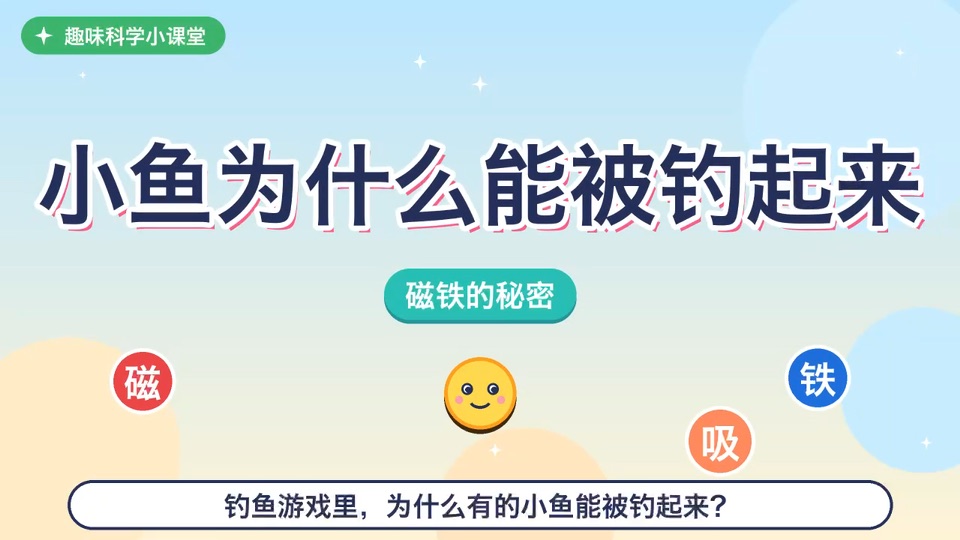
Why Can Some Fish Be Caught?
The rod has a magnet on the end and the catchable fish hide paper clips: magnets attract iron. A magnet even pulls a paper clip out of a glass of water.
📘 Grade 1 Science · Lesson 1- The fishing rod has a magnet on the end.
- Fish with a paper clip (iron) inside are attracted and can be caught.
- Magnets do not attract plastic, wood, paper or cloth.
- A magnet works through a glass of water: it can pull a paper clip out without wet hands.
 0:26
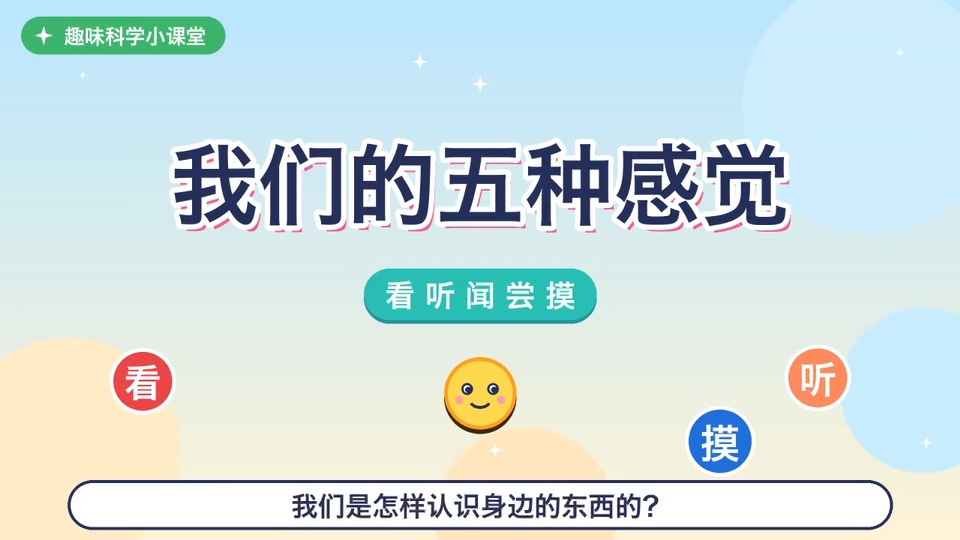
Our Five Senses
Eyes see colour and shape, ears hear sounds, the nose smells, the tongue tastes and the hands feel hard or soft. Never taste things you don’t know!
📘 Grade 1 Science · Lesson 2- Eyes: colour, shape and size.
- Ears: sounds.
- Nose: smells.
- Tongue: tastes, but never taste unknown things!
- Hands (skin): hard or soft, smooth or rough.
 0:48
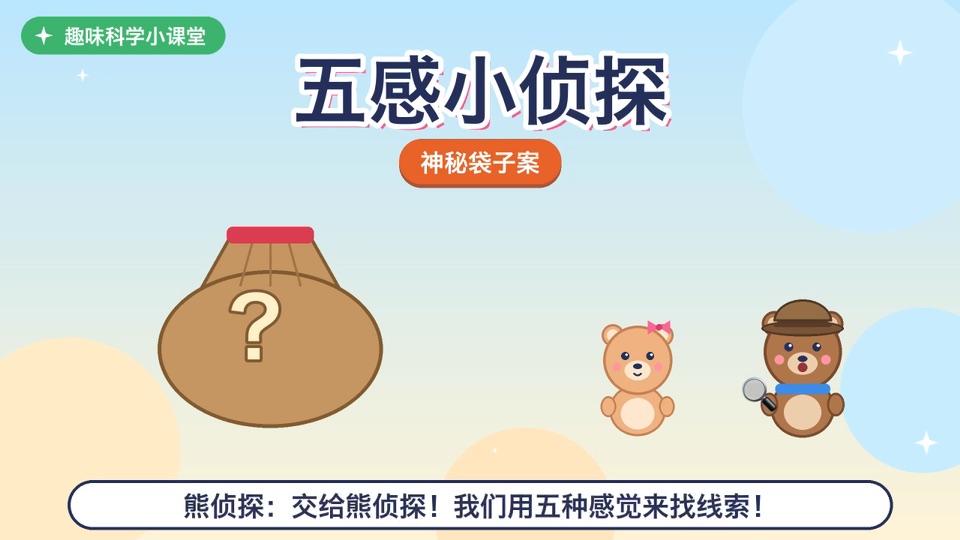
Five-Sense Detective: The Mystery Bag
Detective Bear and Little Bear solve the mystery bag with five clues: look, touch, smell, listen and taste. Red, round and smooth, sweet-smelling, a dull knock, sweet and crunchy — it’s an apple!
📘 Grade 1 Science · Lesson 2- We observe with five senses: eyes, ears, nose, tongue and hands (skin).
- Each sense gives a different clue: colour, shape and feel, smell, sound, taste.
- Smell by wafting the scent towards your nose.
- Never taste things you don’t know.
 0:24
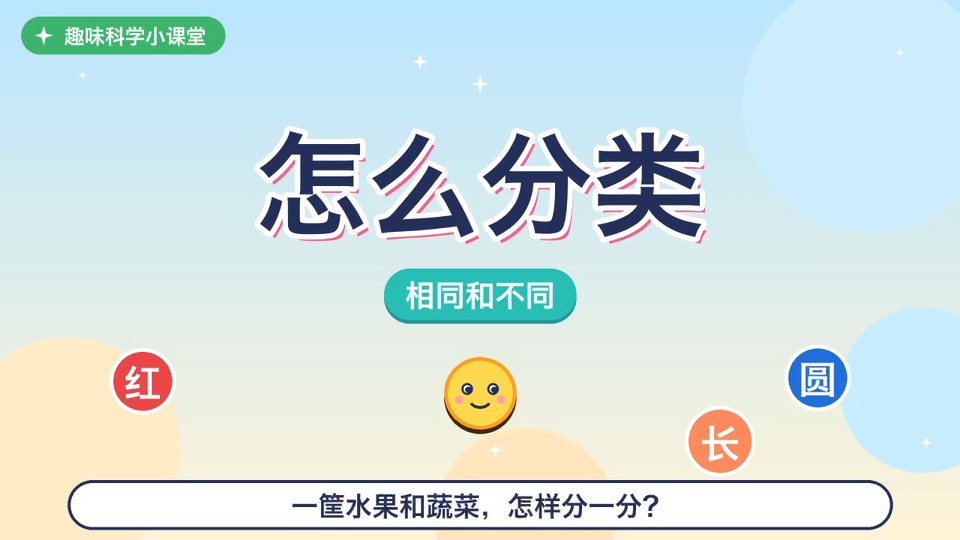
Same and Different: How to Sort
Sort a basket of fruit and vegetables by colour, then by shape. A different rule gives different groups, so first look for what things have in common.
📘 Grade 1 Science · Lesson 3- Compare things to find what is the same and what is different.
- Sort by colour: red, yellow and green groups.
- Sort by shape: round and long groups.
- A different rule for sorting gives different groups.
 0:46
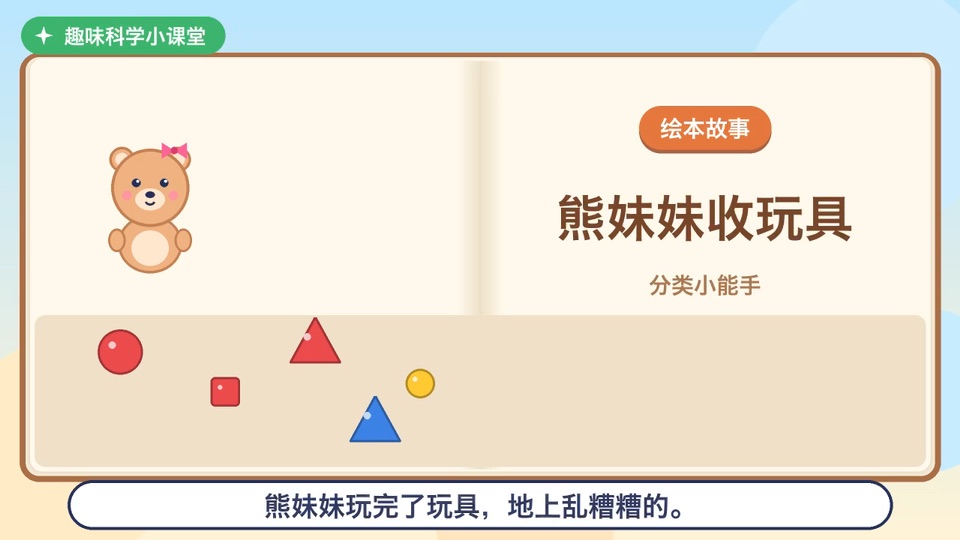
Picture Book: Little Bear Tidies Up
A picture-book story: Big Bear helps Little Bear sort her toys — first by colour, then by shape, then by size. The same toys sort differently because the rule is different.
📘 Grade 1 Science · Lesson 3- To sort, first look for what is the same and what is different.
- You can sort by colour, by shape or by size.
- The same things sort differently when the rule (standard) changes.
 0:42
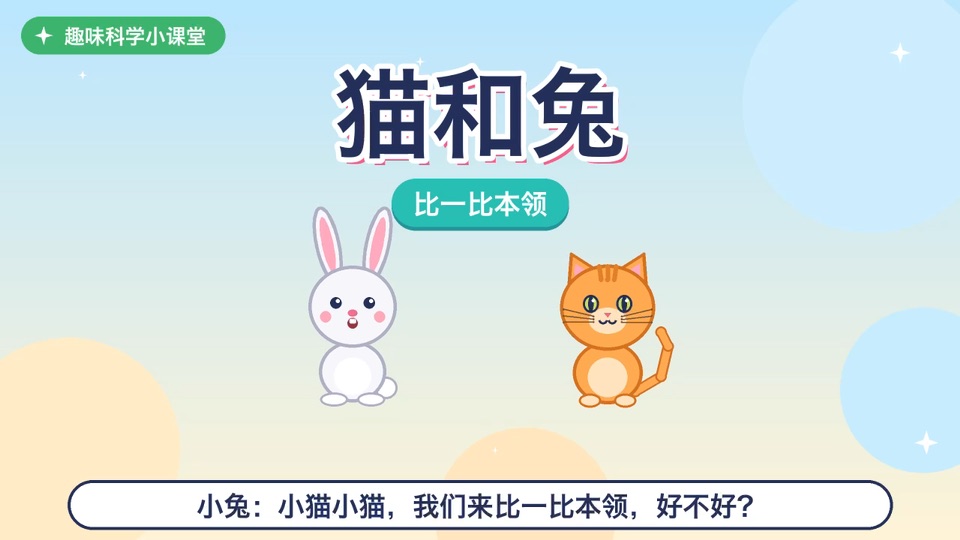
Cats and Rabbits
A kitten and a bunny compare their skills. Rabbits have long ears, hop and love grass and carrots. Cats climb trees and their pupils grow big at night. Both have fur and four legs, eat and grow.
📘 Grade 1 Science · Lesson 5- Rabbit: long ears, hops, eats grass and carrots.
- Cat: sharp claws for climbing; pupils grow big at night so it sees better.
- Same: fur, four legs, they eat and grow.
- Wash your hands after touching animals.
 0:23
What Are Things Made Of?
Wooden chairs, metal spoons, glass cups and cloth shirts. Glass is clear but breaks; metal is strong and shiny; pan handles use wood or plastic because metal gets hot.
📘 Grade 1 Science · Lessons 7–8- Things at home are made of different materials: wood, metal, plastic, glass, ceramic, cloth, paper.
- Glass is clear but breaks easily.
- Metal is strong, shiny and can bend.
- Pan handles are wood or plastic because metal gets hot.
 0:52
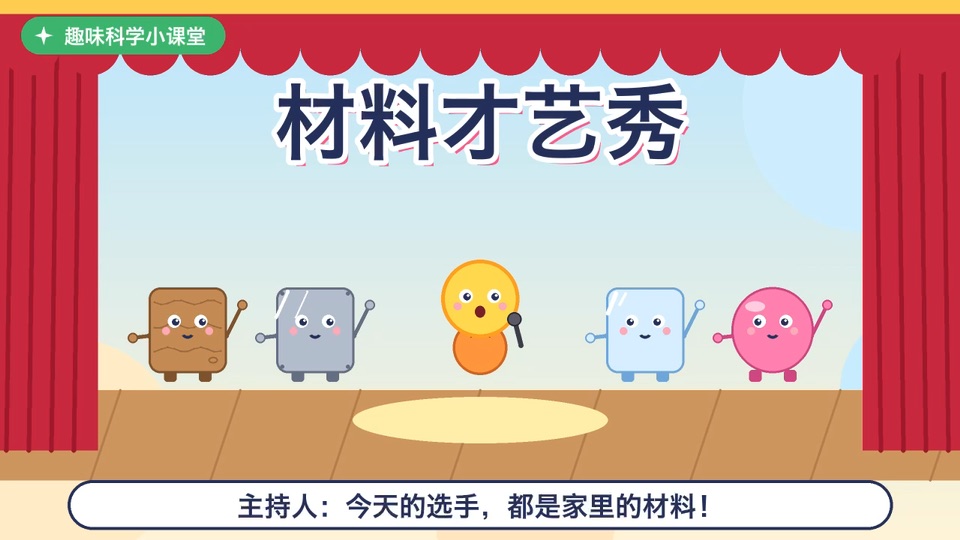
Materials Talent Show
Wood, metal, glass and plastic take the stage to show off: wood is strong and warm, metal shiny and tough, glass clear but breakable, plastic light and colourful. Final challenge: who makes a pan handle?
📘 Grade 1 Science · Lessons 7–8- Wood: strong and feels warm — tables, chairs, pencils.
- Metal: shiny and very strong — spoons, keys, pans; but it gets hot.
- Glass: clear, light passes through — windows, cups; but it breaks easily.
- Plastic: light, colourful, hard to break — toys, buckets.
- Pan handles are wood or plastic because metal gets hot.
 0:30
All Kinds of Leaves
A leaf has a blade and a stalk. Maple leaves look like a hand, pine leaves like needles, lotus leaves like a plate. A magnifier shows the veins.
📘 Grade 1 Science · Term 2 · Lesson 1- A leaf has a wide blade and a thin stalk.
- Leaves of different plants have different shapes: maple like a hand, pine like needles, lotus like a plate.
- The thin lines on a leaf are its veins; a magnifier helps you see them.
- Leaves of different shapes can be put together into a picture.
 0:52
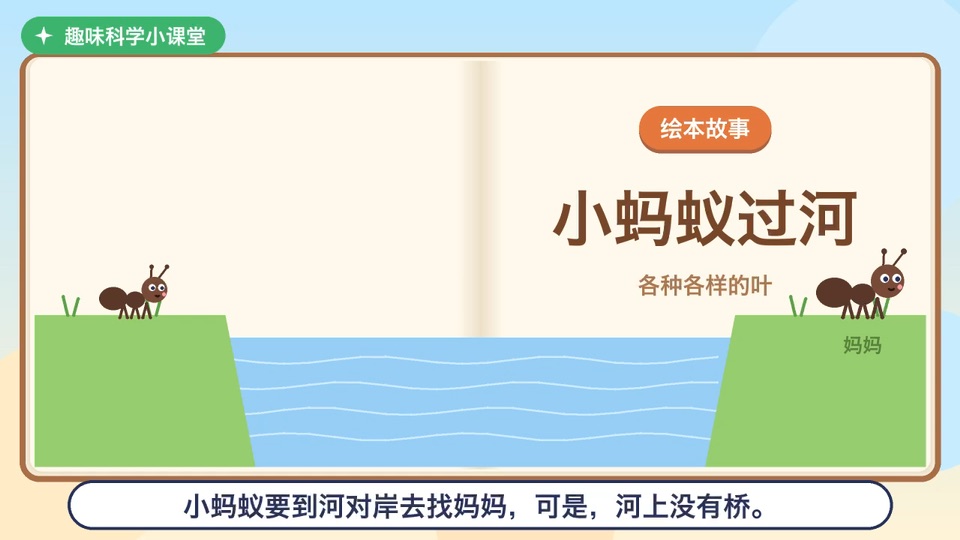
Picture Book: Little Ant Crosses the River
A picture-book story: Little Ant needs a boat made of a leaf. A pine needle is too thin, a maple leaf spins in the water, but a big round lotus leaf works — with its blade to sit on, a stalk to steer and veins on top.
📘 Grade 1 Science · Term 2 · Lesson 1- Leaves of different plants have different shapes.
- A pine leaf is thin like a needle; a maple leaf looks like a hand; a lotus leaf is round like a plate.
- A leaf has a wide blade, a thin stalk, and veins on the blade.
 0:27
Colourful Flowers
Flowers have petals and a centre with stamens. Their colours, shapes and sizes differ, but most have petals and stamens. Smell flowers by wafting, and never taste unknown plants.
📘 Grade 1 Science · Term 2 · Lesson 2- A flower has petals and, in the middle, stamens.
- Flowers differ in colour, shape and size.
- But most flowers have petals and stamens.
- Smell a flower by wafting the scent towards your nose, and never taste plants you don’t know.
 0:57
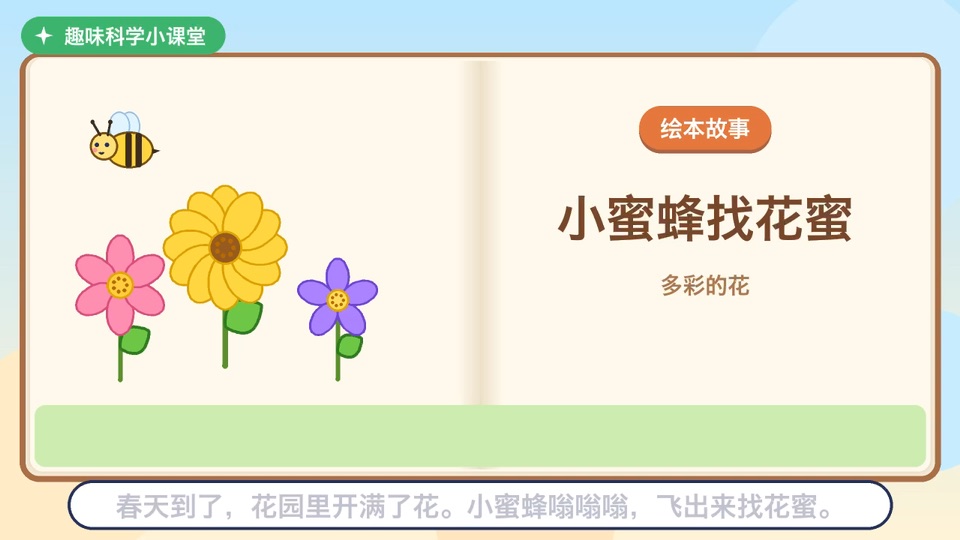
Picture Book: Little Bee Looks for Nectar
A picture-book story: Little Bee visits pink, yellow and purple flowers. They differ in colour, shape and size, but all have petals and stamens. Bee teaches Little Bear to waft a flower’s scent and never taste unknown plants.
📘 Grade 1 Science · Term 2 · Lesson 2- A flower has petals; in the middle are the stamens, where the nectar is.
- Flowers differ in colour, shape and size.
- But most flowers have petals and stamens.
- Smell flowers by wafting; never taste plants you don’t know.
 0:47
Find Directions with the Sun
Little Bear and Big Bear work it out together: the sun rises in the east and sets in the west. Face the sun in the morning: east ahead, west behind, north on the left, south on the right. Maps put north at the top.
📘 Grade 1 Science · Term 2 · Lesson 5- The sun rises in the east and sets in the west.
- Morning, facing the sun: east ahead, west behind, north left, south right.
- Evening, facing the sun: west ahead, east behind, south left, north right.
- On a map: north up, south down, west left, east right.
 0:35
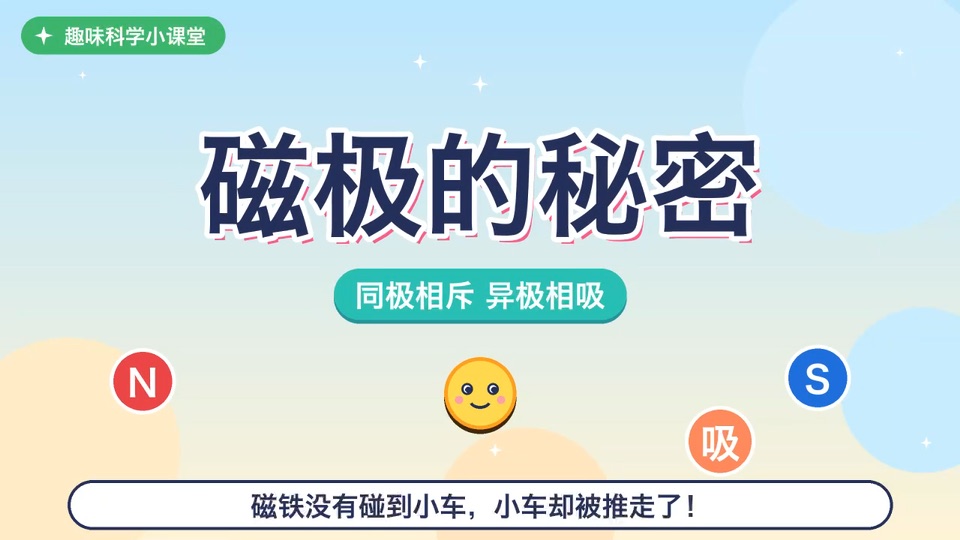
The Secret of Magnet Poles
A bar magnet holds the most paper clips at its two ends — the poles, N and S. Like poles push apart, unlike poles pull together, which is how a magnet can push a toy car without touching it.
📘 Grade 1 Science · Term 2 · Lessons 8–9- A bar magnet picks up the most paper clips at its two ends.
- The strongest parts are the poles: the north pole N and the south pole S.
- Like poles repel (push apart); unlike poles attract (pull together).
- A hanging bar magnet comes to rest with N pointing north.
 0:45
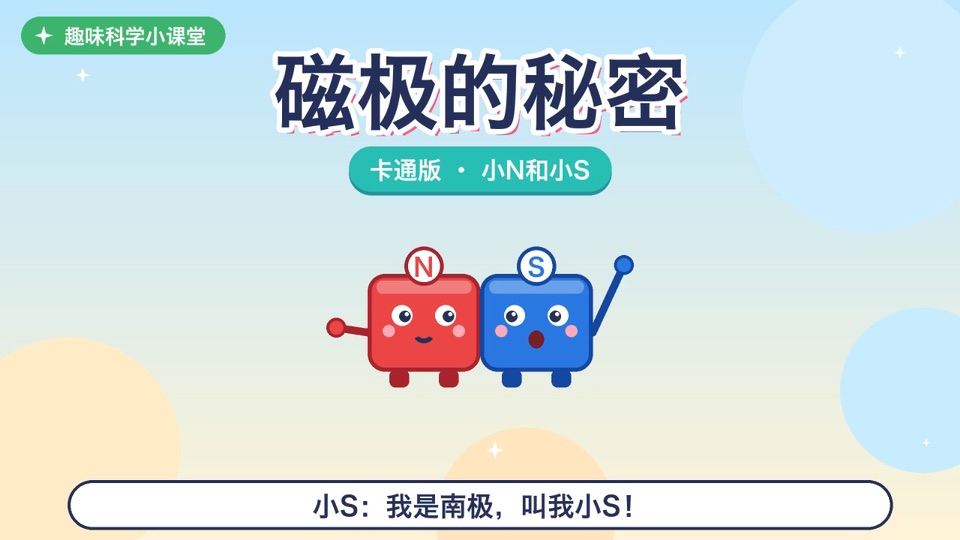
Meet N and S (Cartoon)
Little N and Little S, the two ends of a magnet, tell their own story: they hold the most paper clips, two Ns push each other away, N and S hug tight, and when hung up N points north.
📘 Grade 1 Science · Term 2 · Lessons 8–9- The two ends of a magnet are its poles: the north pole N and the south pole S. They attract iron most strongly.
- Like poles repel: N and N (or S and S) push each other away.
- Unlike poles attract: N and S pull together.
- A hanging bar magnet comes to rest with N pointing north and S pointing south.
 0:37
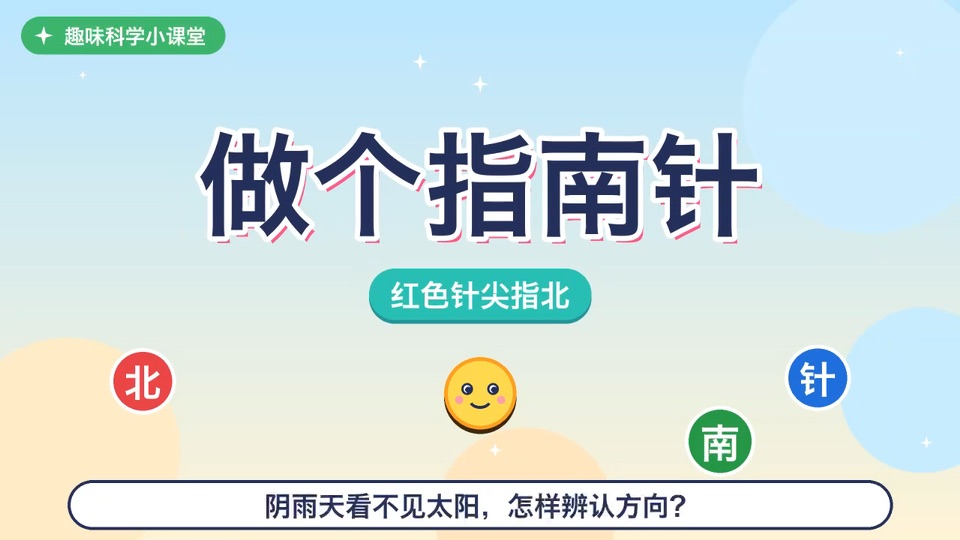
Make a Compass
A compass has a case, a dial and a magnetic needle whose red tip always points north. Turn the dial so north lines up with the red tip. Rub a sewing needle with a magnet and float it on water to make your own.
📘 Grade 1 Science · Term 2 · Lessons 10–12- A compass has a case, a dial and a magnetic needle — the needle is a tiny magnet.
- However you turn the compass, the red tip points north.
- To use it: hold it flat, turn the dial until N lines up with the red tip, then read the directions.
- Rub a sewing needle 20+ times in one direction with a magnet, then float it on water.
 0:54
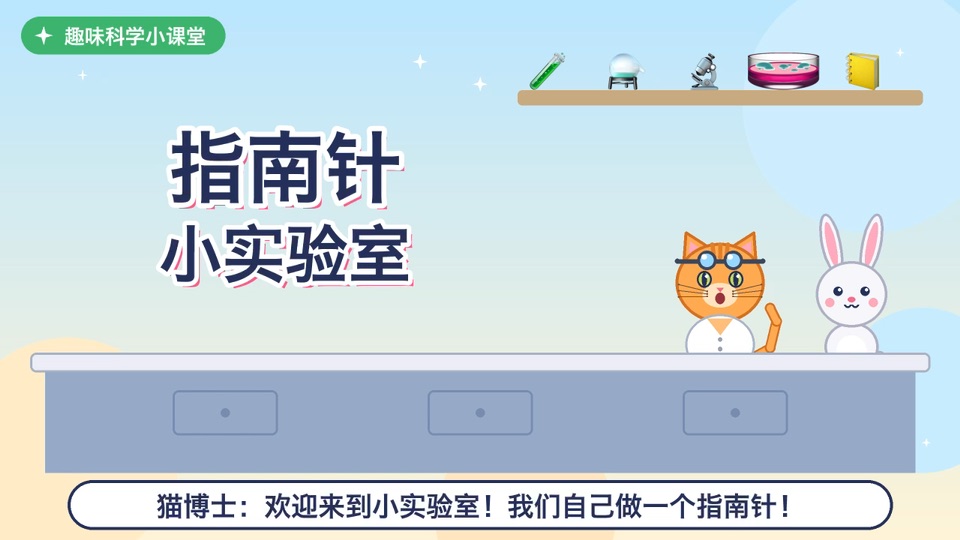
Compass Lab
Dr Cat and Bunny make a compass in the lab: gather the materials, guess what will happen (3-2-1!), rub a needle with a magnet, test it on paper clips, float it on water — and it points north and south.
📘 Grade 1 Science · Term 2 · Lessons 10–12- Materials: a sewing needle, a magnet, a piece of foam and a bowl of water.
- Guess first, then test: does the needle become a magnet?
- Rub the needle with one end of the magnet 20+ times in one direction — careful with the sharp tip!
- The magnetised needle picks up paper clips; floating on foam it turns and points north–south.
 0:45
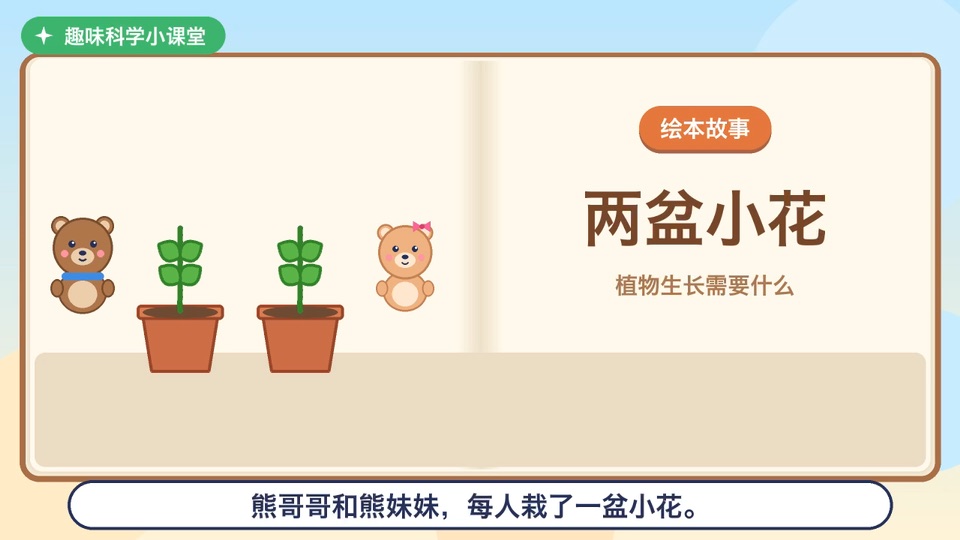
Picture Book: Two Little Flowers
Big Bear keeps his flower on the sunny balcony and waters it; Little Bear forgets hers in a dark cupboard. A week later one blooms and one wilts — plants need water, sunlight and air.
📘 Grade 2 Science · Term 1 · Lessons 1–2- To plant a pot: add soil, plant the seedling, water it, add a name label.
- Plants need water, sunlight and air to grow well.
- A plant in the dark without water turns yellow and wilts; give it sun and water and it recovers.
 0:42
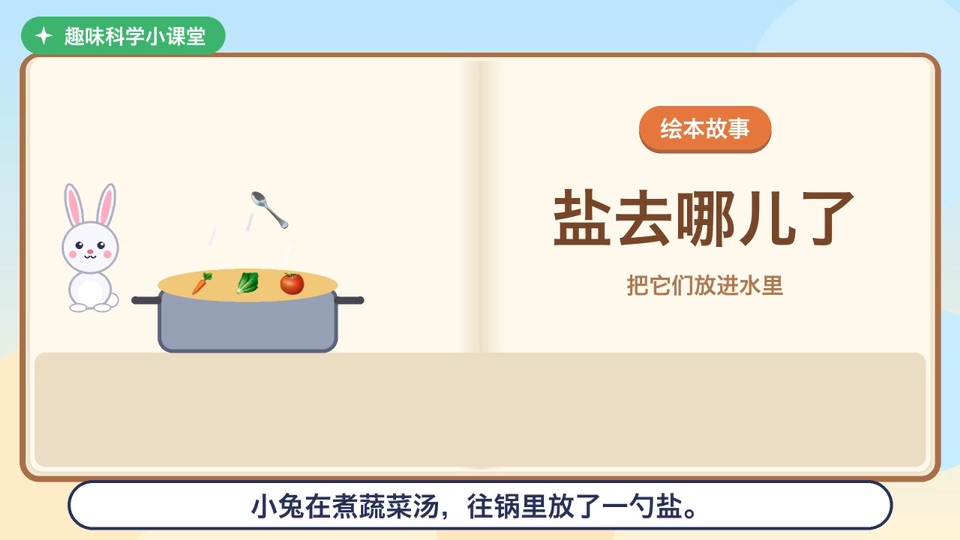
Picture Book: Where Did the Salt Go?
Bunny’s salt vanishes in the soup. Dr Cat tests sugar, salt, sand and oil in water: sugar and salt dissolve, sand sinks, oil floats. Leave salty water in the sun and the salt comes back!
📘 Grade 2 Science · Term 1 · Lesson 5- Sugar and salt get smaller and disappear in water: they dissolve.
- Sand sinks and oil floats: they do not dissolve.
- Dissolved salt is still there; when the water dries up, the salt appears again.
 0:51
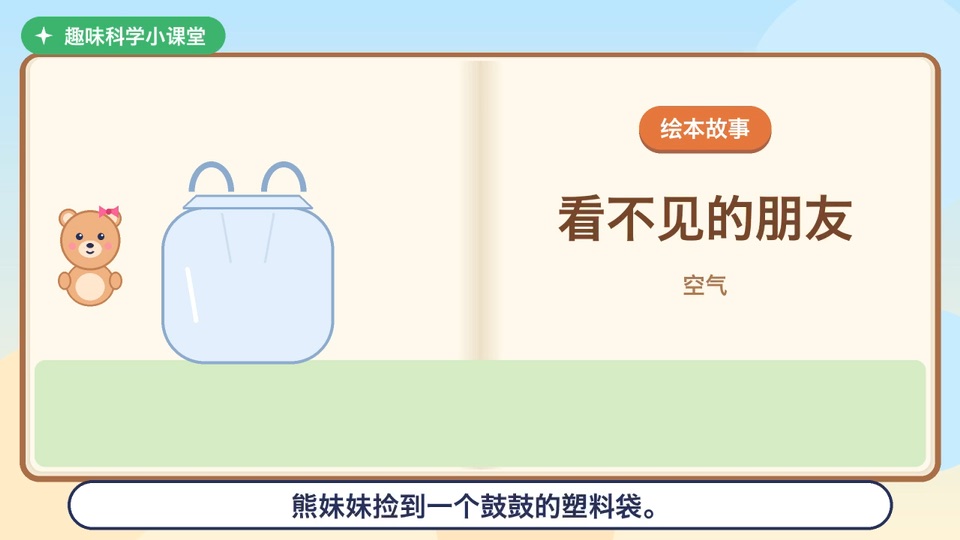
Picture Book: The Invisible Friend
Little Bear finds a puffy bag — and Air Baby pops out! You can’t see, smell or taste air, but bubbles prove it’s there. Air flows, has no fixed shape, makes wind, and we breathe it.
📘 Grade 2 Science · Term 1 · Lesson 6- Air has no colour, smell or taste; you can’t see or touch it.
- Push a bag of air into water and poke it: bubbles come out.
- Air flows and has no fixed shape; moving air is wind.
- We need air to breathe; fire needs air; tyres are filled with air. Keep air clean!
 0:48
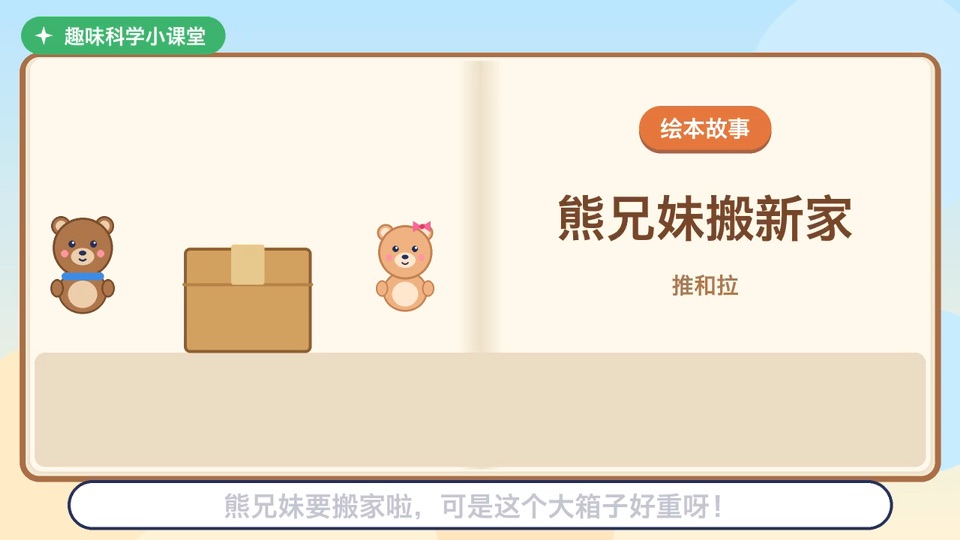
Picture Book: The Bears Move House
Big Bear pulls and Little Bear pushes the heavy box. Pulling is towards you, pushing is away. Pushes and pulls move things and change their shape; a cart makes it easier, and rowing uses both.
📘 Grade 2 Science · Term 1 · Lessons 7–9- Pull: force towards yourself; push: force away from yourself.
- Pushes and pulls can move things (change their position).
- They can also change shape: a pulled spring gets longer, a pressed sponge gets flatter.
- Use force wisely: carts make loads easier; rowing a boat uses both pushing and pulling.
 0:52
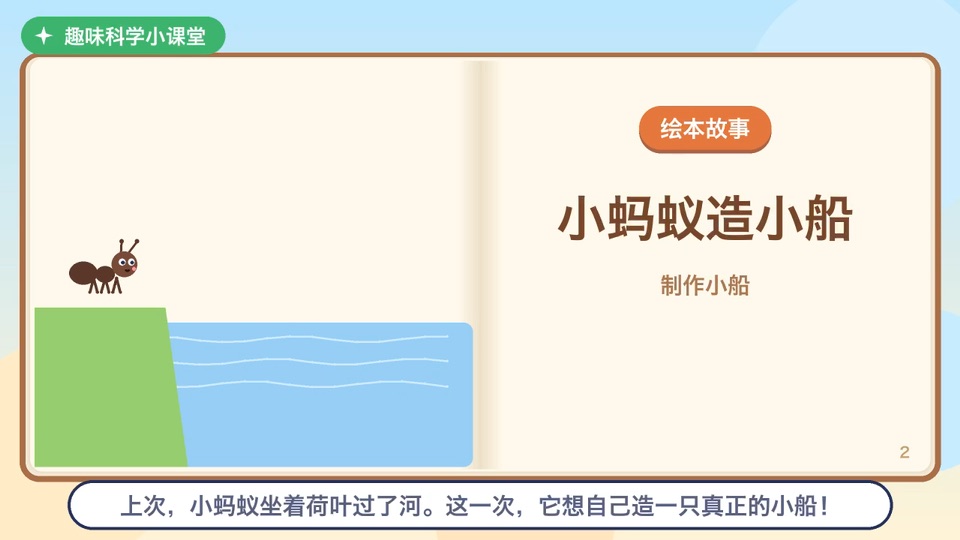
Picture Book: Little Ant Builds a Boat
Little Ant draws a design (bow, stern, deck, cabin, mast, sail), builds the boat from foam, a straw and paper, then tests it: it tips over, so she shortens the mast; it leaks, so she waterproofs the cabin. Success!
📘 Grade 2 Science · Term 1 · Lessons 10–12- A ship has a bow, stern, deck, cabin; a sailboat also has a mast and a sail.
- Draw a design first and mark the materials: foam for the hull, a straw for the mast, paper for the sail.
- Test: if the boat tips over, lower the mast; if the cabin leaks, waterproof it.
- Design → make → test → improve. Use scissors safely.
 0:52
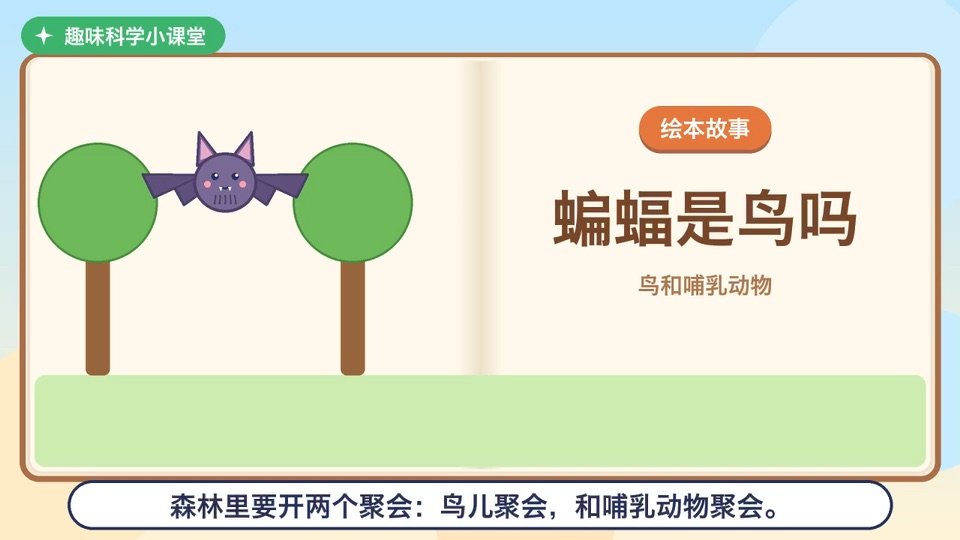
Picture Book: Is a Bat a Bird?
Little Bat flies to the birds’ party, but has no feathers or beak. At the mammals’ party it fits right in — fur, and babies fed on milk. Whales are mammals too, not fish.
📘 Grade 4 Science · Term 1 · Lessons 1–2- Birds: wings and feathers, a horny beak, scaly feet; most can fly.
- Mammals: fur on the body, babies fed on milk.
- Bats can fly but are mammals; whales live in water but are mammals.
- Classify animals by their main features, not by where they live or whether they fly.
 0:45
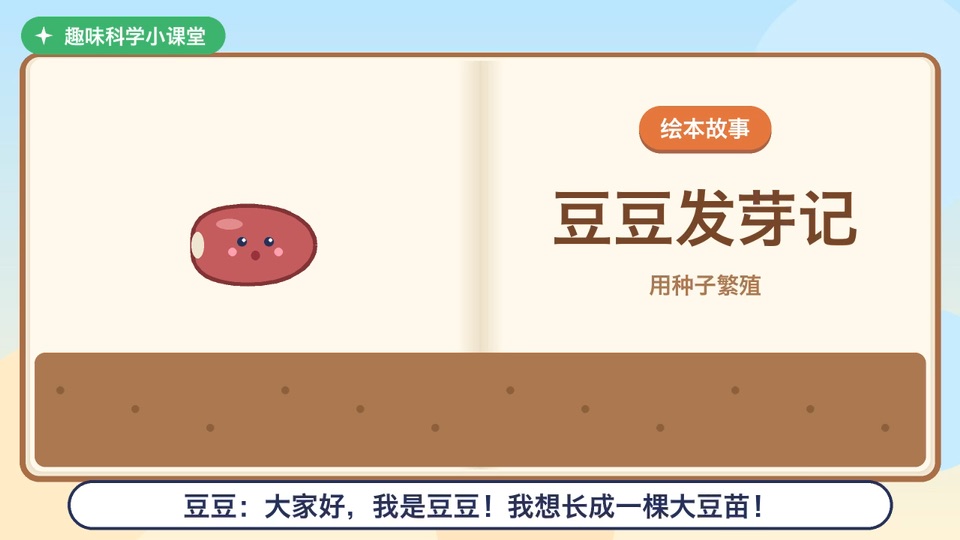
Picture Book: Bean Sprouts
Bean shows its seed coat and embryo (cotyledons, plumule, radicle). It needs water, warmth and air to sprout — not sunlight. The root goes down, the shoot grows up, and new beans grow.
📘 Grade 4 Science · Term 1 · Lesson 5- A bean seed has a seed coat and an embryo: cotyledons (food store), plumule and radicle.
- Seeds need water, suitable warmth and air to germinate; light is not needed.
- Too dry, under water or in the fridge — no sprouting. Change only one condition in a fair test.
- The radicle grows down into roots, the plumule grows up into stem and leaves.
 0:48
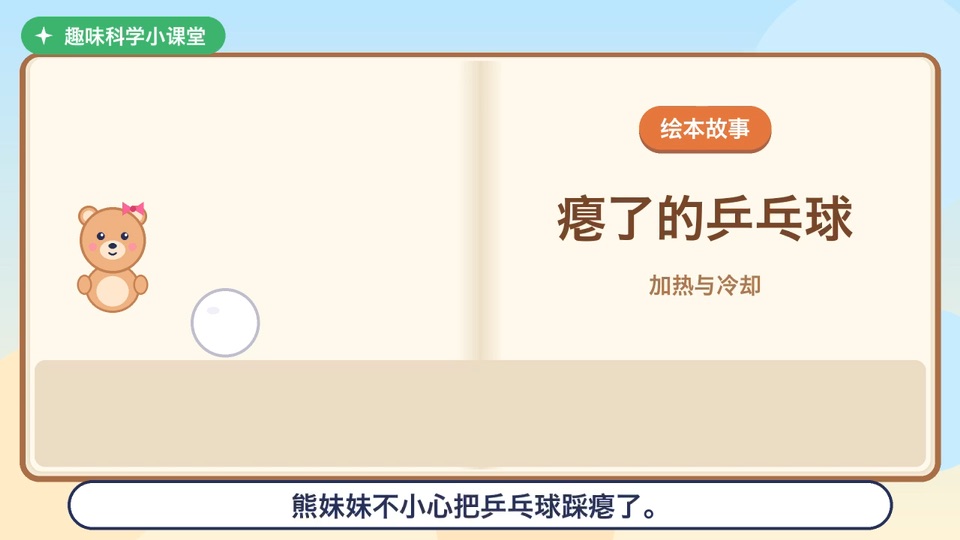
Picture Book: The Dented Ping-Pong Ball
Little Bear’s dented ping-pong ball pops back out in hot water: the air inside expands. Water expands too — that’s how thermometers work. Rails have gaps, sky lanterns rise, and ice is the exception.
📘 Grade 4 Science · Term 1 · Lessons 7–9- Air expands when heated: a dented (unbroken) ping-pong ball pops out in hot water.
- Water expands when hot and shrinks when cold; thermometers use this.
- Solids expand too: rails need gaps, power lines sag in summer.
- Hot air rises (sky lanterns); water expands when it freezes — an exception.
 0:55
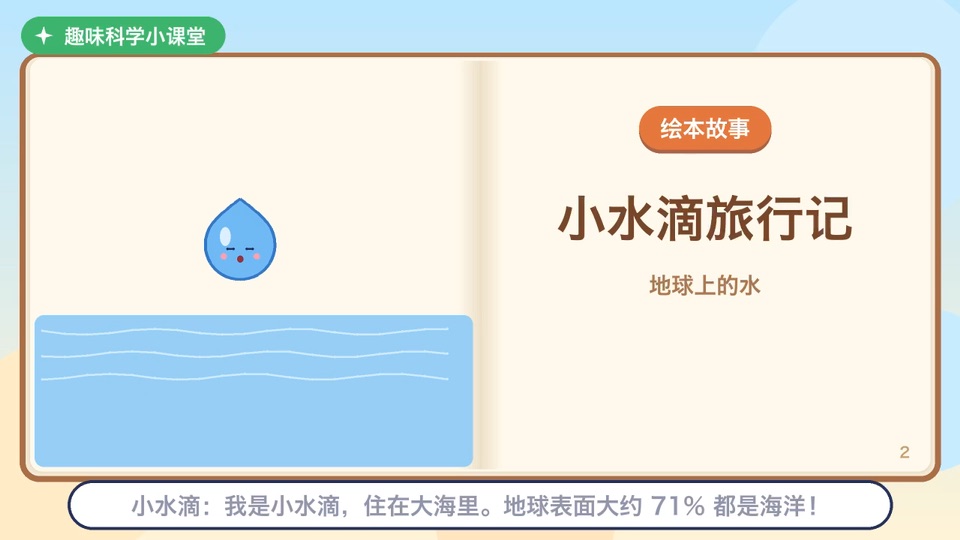
Picture Book: Little Drop’s Journey
Little Drop lives in the ocean (71% of Earth’s surface), evaporates into vapour, condenses into clouds and rain, freezes at 0 °C and boils at 100 °C. Fresh water is scarce — save water!
📘 Grade 4 Science · Term 1 · Lessons 10–12- Oceans cover about 71% of Earth’s surface, land about 29%.
- Water evaporates into vapour; vapour cools and condenses into clouds and rain.
- Water freezes at 0 °C (and expands) and boils at 100 °C.
- Water has three states — solid, liquid, gas — that change into each other. Fresh water is scarce.
 0:50
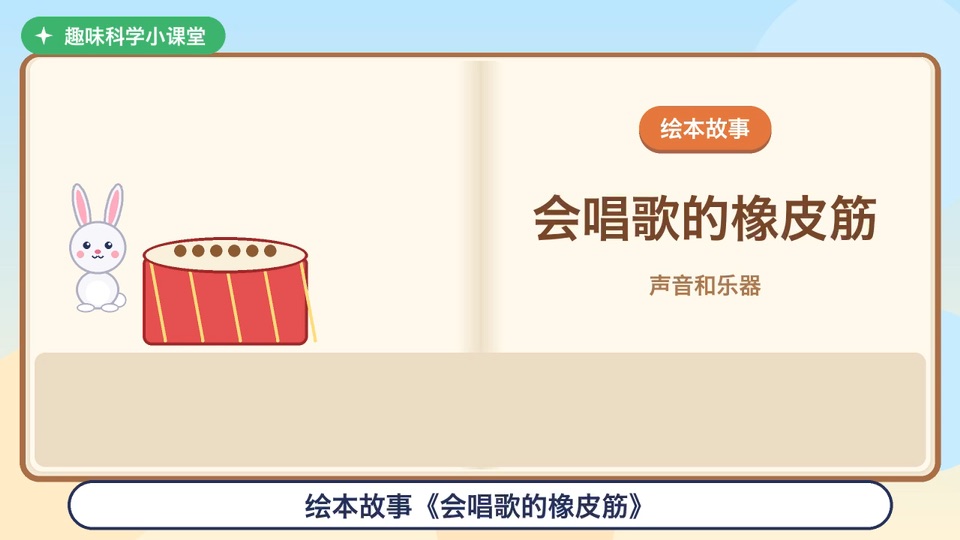
Picture Book: The Singing Rubber Band
Dr Cat shows Bunny that sound comes from vibration, travels through air, water and solids (but not a vacuum), is louder with bigger vibrations and higher with faster ones. Bunny makes a straw panpipe!
📘 Grade 4 Science · Term 1 · Lessons 13–17- Sound is made by vibration: beans jump on a beaten drum.
- Sound travels through gases, liquids and solids in all directions; not through a vacuum.
- Bigger vibrations → louder; faster vibrations → higher pitch (tighter, shorter, thinner).
- Short straws play high notes, long ones low. Music vs noise — protect your hearing.
No video covers that yet — try another word.
🧩 Brain games › More games
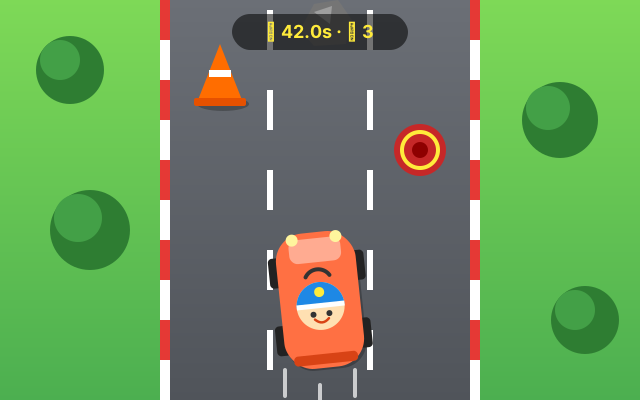
Little Racer
Steer a little car with your mouse or finger and dodge cones, rocks and barrels. Every 20 seconds it speeds up; whoever lasts longest tops the leaderboard.
Play now →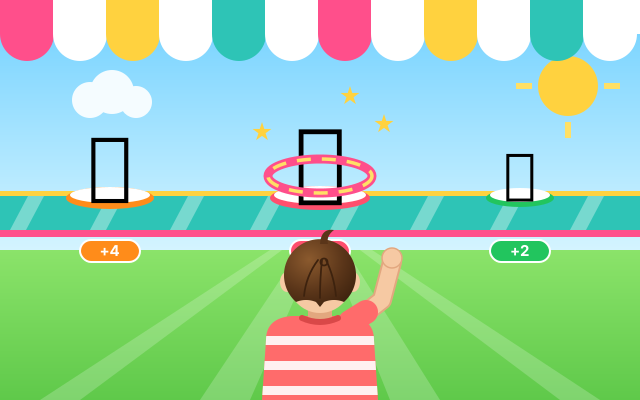
Ring Toss Fair
Time your throw to ring a cow, horse, donkey, chicken or bird as they roll past, then click as fast as you can to pull it in. Bigger animals score more, and fight back harder!
Play now →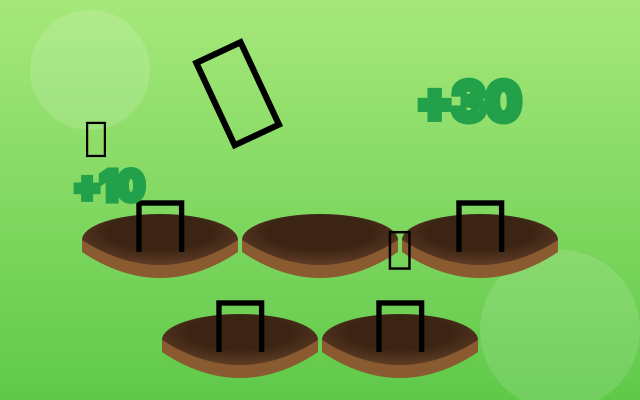
Hamster Whack
Hamsters pop out of their holes: tap them fast! Golden ones are worth more, but don't hit the bombs or the bunny. 8 levels, each a little faster.
Play now →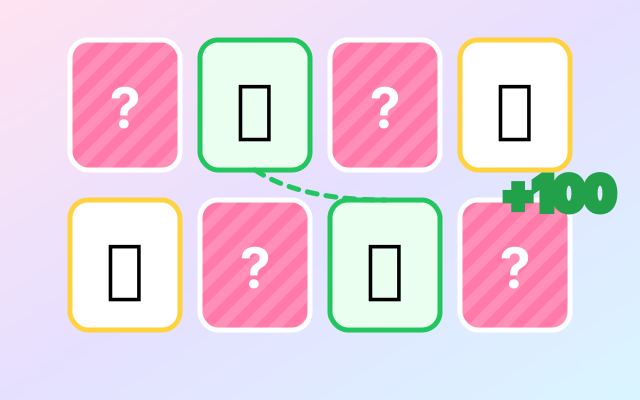
Flip & Match
Flip two cards and find the matching pairs. Take a peek first, then remember! From 3 pairs of animals up to 15 mixed pairs across 6 levels.
Play now →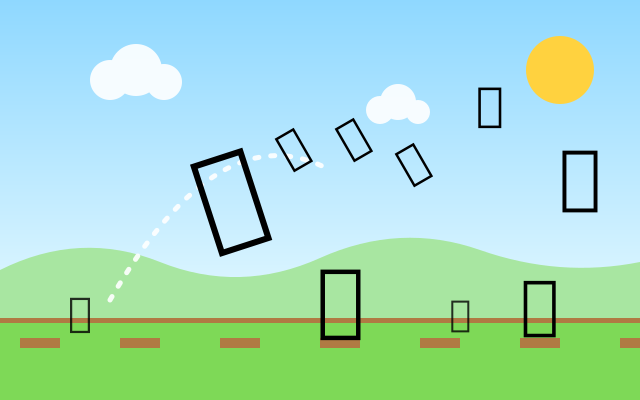
Bunny Hop
Tap to jump, tap again in the air to double-jump! Help the bunny grab carrots across a meadow, forest, desert, snow, candy land and a starry night.
Play now →The games' on-screen text is in Chinese for now.
What would you like to learn today?
Type, talk, snap a photo of your homework or upload a file — AI will turn it into a learning game or a short video.
🔥 Popular creations
Games and videos everyone is enjoying — pick one and play!
Coming soon
AI creation is on its way! We’re still building it — check back soon.